
5G Unified Communications: How High-Speed Networks Support Converged Services

Edge Computing and Media Handling for 5G Unified Communications
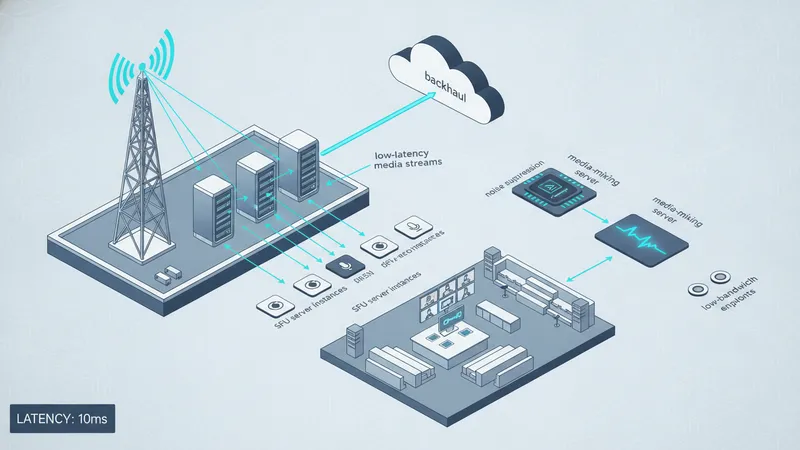
Edge compute nodes are often positioned to reduce the distance that real-time media must travel, which can lower round-trip latency for interactive voice and video. Typical edge functions for unified communications include media mixing, transcoding, recording, and AI-based enhancement such as noise suppression. Deploying these functions near radio aggregation points may help conserve backhaul capacity and improve responsiveness for geographically concentrated user groups. Architects may plan edge capacity by profiling expected concurrent sessions and media-processing load.
Media-handling strategies commonly include selective forwarding units (SFUs) for multiparty video, where media streams are forwarded with minimal server-side mixing, and media servers that perform mixing when necessary for low-bandwidth endpoints. In edge deployments, SFUs may scale horizontally across instances to handle bursts in conference participants. Decision factors for SFU versus mixing approaches often include endpoint capabilities, expected group sizes, and the latency sensitivity of the application.
Real-world deployments often balance edge placement against operational complexity: more edge nodes can reduce latency but increase orchestration and state synchronisation requirements. Considerations include how stateful session information is replicated, how failover is handled, and how analytics are aggregated for monitoring. These are typically design trade-offs rather than absolute rules, and choices often reflect an operator’s topology and expected traffic patterns.
Looking ahead, integration between edge-hosted media services and network orchestration may enable more dynamic placement of processing tasks based on live load and user location. Such coordination may be beneficial for unified communications because it can match processing location to current session needs. The next page expands on mobility and client-side considerations for converged services.