
Heating Element Manufacturers: Key Production Processes And Industry Standards

Companies that produce resistive heating components create devices that convert electrical energy into heat for industrial, commercial, and consumer applications. This work covers selection of conductive and sheath materials, geometric and electrical design, methods to assemble resistive elements into housings, and the documentation and testing needed to demonstrate performance. Production ranges from single-piece cartridge heaters to continuous coils and complex infrared emitters, and manufacturing practices vary according to required temperatures, environmental exposure, and intended service life.
Manufacturing these components typically involves iterative design and engineering to balance resistance, watt density, thermal expansion, and mechanical robustness. Firms consider manufacturability alongside application constraints: ease of assembly, required tolerances, and end-user safety expectations. Process controls, material sourcing, and adherence to safety and environmental standards often shape production workflows and the inspection criteria applied during and after fabrication.
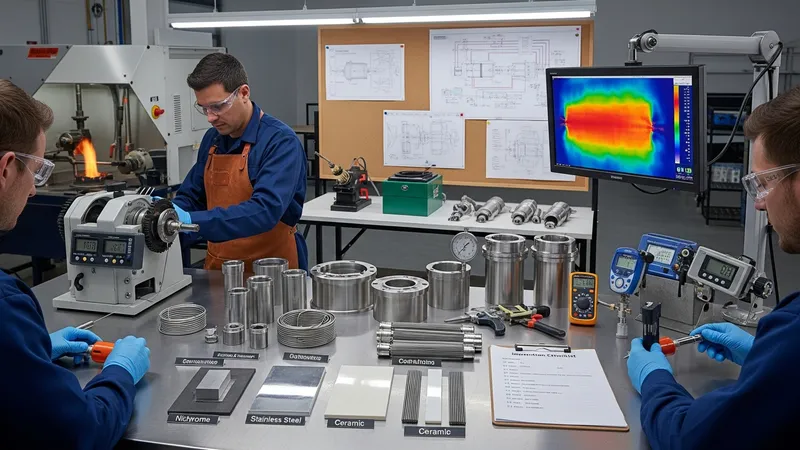
- Nichrome wire wound into cartridge or coil heaters — a wire-based approach commonly used where flexible geometry and medium-to-high temperatures are required.
- Tubular metal-sheathed elements with magnesium oxide insulation — a construction often applied for immersion, dryer, and process heating due to mechanical protection and thermal transfer characteristics.
- Ceramic and infrared emitter elements — ceramic-based resistive formulations or coated metallic elements used in radiant heating and surface-mount applications.
Material selection is central to performance and longevity. Resistance alloys such as nickel-chromium and iron-chromium-aluminium are often chosen for their stable resistivity at elevated temperatures and reasonable oxidation resistance. Sheath materials including stainless steels and copper alloys are selected based on corrosion exposure, required thermal conductivity, and mechanical strength. Designers may trade off higher conductivity for lower surface temperature or select thicker sheaths where mechanical wear is a concern. Supply-chain consistency for these alloys can also affect batch-to-batch variation and must be managed.
Fabrication methods commonly include wire forming, coil winding, insertion into ceramic cores, compacting MgO powder for tubular elements, and laser or arc welding for end fittings and terminals. Automated winding and insertion stations can increase repeatability, while manual finishing may remain necessary for specialized shapes. Sealing techniques — brazing, welding, or epoxy seals — are selected for compatibility with operating temperatures and environmental exposure. Production yield often depends on controlling particulate contamination and achieving consistent compaction or densification where insulation powders are used.
Quality control processes typically combine electrical, thermal, and mechanical tests. Resistance measurements and insulation resistance checks may be performed on every unit, while accelerated life tests, thermal cycling, and corrosion exposure tests are often conducted on sample batches. Thermal imaging and surface temperature mapping can verify even heat distribution and identify hot spots. Traceability via serial numbers or batch codes helps correlate in-field failures with production records and material lots. Documentation of test results and control limits may be needed for procurement and regulatory review.
Safety and industry standards guide design margins, labeling, grounding, and temperature-limiting provisions. Compliance often involves reference to general electrical safety frameworks and, where applicable, product-type standards that specify construction and test methods. Environmental regulations may require restrictions on certain alloys or coatings and call for material declarations. Manufacturers commonly maintain certifications or third-party test reports to demonstrate conformance; however, specific requirements depend on application, market, and end-use safety obligations.
Manufacturers often align production, test planning, and documentation to customer application cases so that elements meet projected duty cycles and environmental conditions. Typical considerations include specifying allowable watt density, anticipated duty cycle, and the presence of corrosive media, which may influence both design and inspection routines. This overview has outlined core components of production and standards; the next sections examine practical components and considerations in more detail.