
AI-Powered Email Tools: How Automation Supports Lead Generation Workflows

Automated systems that combine machine learning, natural language processing, and predefined rules can analyze prospect activity and generate email actions with minimal human intervention. In practical terms, these systems ingest inputs such as form submissions, click behavior, website visits, and CRM records, then apply models or templates to assign lead intent scores, select message variants, and schedule sends. The overall aim is to create repeatable sequences that move contacts through stages commonly associated with lead development, while reducing manual steps in list management and message assembly.
Core functions typically include classifying incoming contacts, segmenting audiences by inferred interest or value, and composing messages that match a recipient’s context. Automation may route higher-scoring contacts into faster or more tailored sequences and may suppress outreach for contacts who recently converted or unsubscribed. Implementations vary: some use simple rule engines with conditional branching; others layer predictive models that update scores as new signals arrive. The following concise examples illustrate representative methods and tool types used in these workflows.
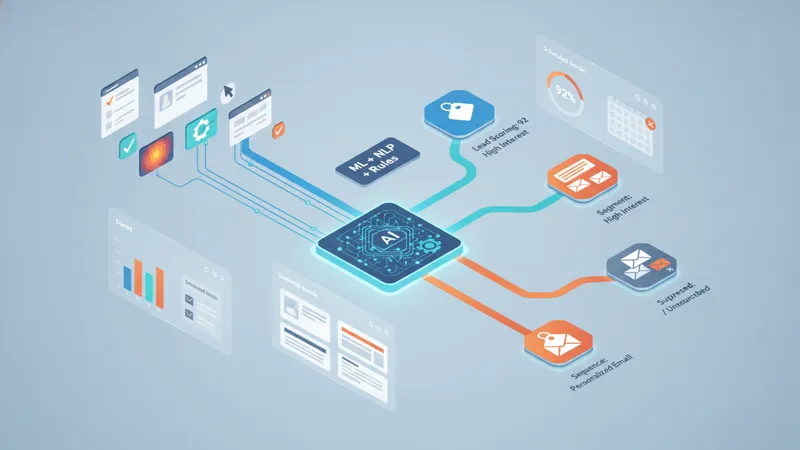
- Predictive lead scoring models — statistical or machine-learning approaches that aggregate behavioral and firmographic signals to produce a score indicating likely engagement or readiness; these may be embedded in marketing platforms or exposed via APIs.
- Automated content generation (NLG templates) — systems that assemble subject lines and body content from modular templates and variable fields, sometimes augmented by generative text models to produce personalized variants.
- Behavior-triggered workflow engines — event-driven automations that initiate email sequences based on specific triggers such as form completion, page visits, link clicks, or CRM status changes.
Comparatively, rule-based and model-driven methods often coexist within the same system. Rule-based logic may handle compliance and simple routing (for example, suppressing sends to unsubscribed contacts), while predictive scores may prioritize outreach within those rules. Organizations that adopt mixed approaches typically gain practical control: deterministic rules maintain governance, and probabilistic models guide prioritization. This combination can also ease auditability, because rules are explicit and model outputs can be logged for later review rather than acting as sole decision-makers.
Segmentation strategies informed by automated tools often rely on both explicit data (form fields, purchase history) and implicit signals (time on site, email opens). AI components can cluster recipients into microsegments that may not be obvious from manual inspection, but these clusters should be interpreted with care. Analysts often validate automated segments against conversion patterns before widely deploying new sequences. Measurement frameworks that incorporate holdout groups or A/B tests may help determine whether automated segmentation produces material differences in lead progression without assuming uniform effects across audiences.
Personalization through content generation may increase message relevance, yet it can also introduce risks if templates or models produce inaccurate assertions about a contact’s status. Typical mitigations include using verified CRM fields for factual statements, limiting generative text to descriptive or neutral phrases, and maintaining content preview steps. In many setups, dynamic fields are combined with template logic so that personalization adapts to available data without overstating unknown attributes, thereby reducing the chance of misleading recipients.
Operationally, automated follow-up sequences and scheduling logic often balance engagement patterns and sending cadence. Systems may delay follow-ups after certain events (for example, a recent purchase) or escalate contact frequency based on scoring thresholds. Scheduling algorithms can account for time zones and customary business hours, and they may back off if engagement signals indicate disinterest. These behaviors typically require ongoing tuning: what works for one audience segment may not transfer directly to another without adjustments informed by observed metrics.
In summary, these automated approaches to email-driven lead workflows combine scoring, segmentation, templating, and event-driven logic to reduce manual orchestration while preserving governance through explicit rules. Implementations vary by technical maturity, data availability, and organizational priorities; therefore, understanding the interplay between deterministic rules and probabilistic models is often critical. The next sections examine practical components and considerations in more detail.