
Automatic Pallet Wrapping Machine: How Automated Stretch Wrapping Systems Work

Automated pallet wrapping: system types and film application methods
System selection often centers on how film is applied: by rotating the pallet (turntable) or by moving the film head around the pallet (rotary arm/ring). Turntable configurations may be favored where pallets are standard and floor space allows a rotating platform; they can integrate into conveyor lines with lift-and-transfer stations used in Mexican plants. Rotary arms are more common where palletization patterns vary or goods are taller, since the stationary pallet reduces lateral stress. Film application methods also differ by carriage type—some carriages traverse the load vertically while others combine vertical travel with variable wrap patterns that add reinforcement at pallet edges.
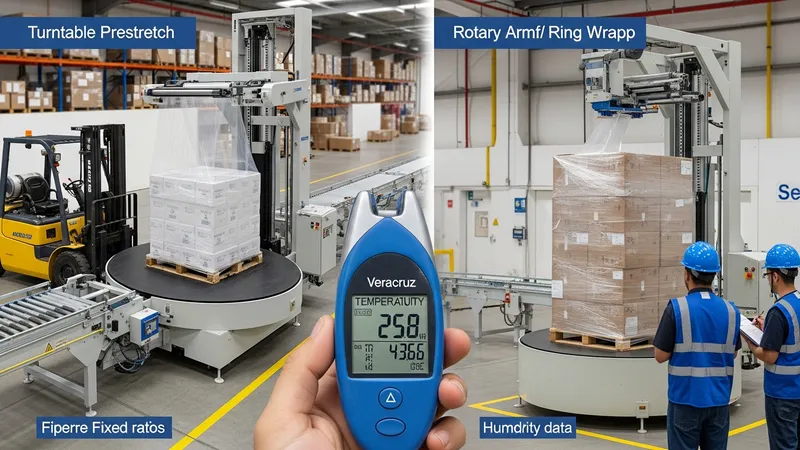
Prestretch and tension control are central to film performance. Mechanical prestretch units in Mexico may use fixed roller ratios that provide consistent elongation, while servo-driven carriages allow adjustable prestretch to respond to different film formulations. Higher prestretch ratios can lower film usage by increasing the film’s hold per meter, but they may require film formulated for higher stretch and tear resistance. Facilities often trial film grades under local temperature and humidity conditions—relevant in coastal operations in Veracruz versus inland warehouses in Saltillo—since environmental factors can affect cling and film behavior.
Load profile and pallet format are practical inputs to method choice. For stable, evenly stacked loads, a moderate wrap count with banding at the base and top may stabilize the stack adequately. For mixed or irregular loads, careful wrap pattern programming that adds multiple bottom wraps and cross-wraps at weak points can improve containment. In Mexican food and beverage distribution centers, for example, secondary packaging and pallet overhang are assessed before selecting wrap patterns. These assessments typically inform carriage speed, number of wraps, and film width selection.
Operational planners in Mexico often consider film logistics—storage, roll diameter limits, and waste handling—when specifying systems. Film rolls chosen to match local supply chain sizes may reduce changeovers and storage footprint. Some facilities adopt roll-handling accessories and film shuttles to speed replacements and reduce manual handling risks. While specifying film and method, teams may consult local suppliers for trial rolls and small-scale testing before scaling settings across multiple lines to ensure consistent performance under local operating conditions.