
Cloud Security: Managing Data Protection, Privacy, And Compliance Risks

Identity and access management considerations for cloud data protection
Identity and access management (IAM) plays a central role in limiting who and what can access cloud resources. Typical components include centralized user directories, role definitions, conditional access policies, and multi-factor authentication. Organizations often adopt least-privilege principles to reduce exposure, granting rights narrowly and for limited durations where feasible. Integrations with third-party identity providers may facilitate single sign-on across multiple services, while service accounts and machine identities require distinct lifecycle controls to avoid orphaned credentials. Considerations also include the auditability of access events and the segregation of duties to support compliance.
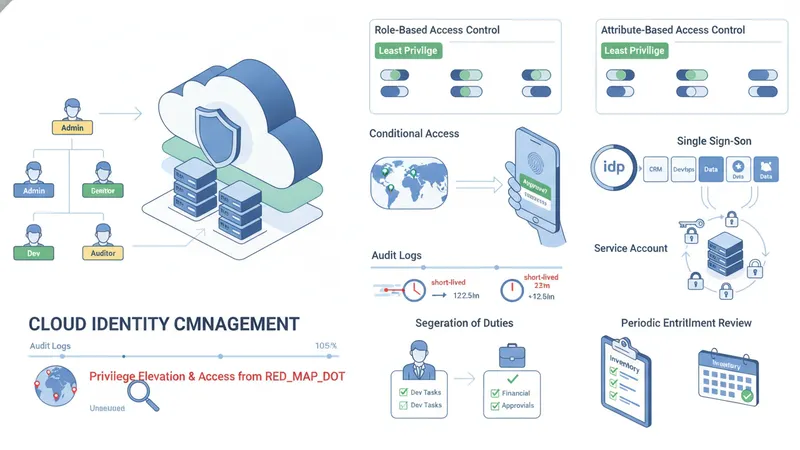
When designing IAM for cloud deployments, teams commonly map privileges to job functions and apply role-based or attribute-based controls to enforce boundaries. Temporary credential mechanisms, such as tokenized sessions or short-lived keys, can reduce the risk of long-term credential compromise. Monitoring of access patterns—such as unusual privilege elevation or access from uncommon geographies—may be incorporated into detection rules. It is also useful to maintain an inventory of privileged accounts and to periodically review entitlement lists to identify stale or excessive permissions as part of routine governance.
Service-to-service authentication and authorization are often managed differently than human identities. Approaches include managed identities, OAuth-based tokens, and mutual TLS for service authentication. These mechanisms may be combined with policy engines that evaluate contextual factors before granting access. Managing secrets for services—API keys, certificates, and credentials—typically involves secure storage solutions or secret management services that provide rotation and access auditing. Ensuring that automation scripts and CI/CD pipelines avoid hard-coded secrets can reduce accidental exposures.
From a compliance viewpoint, IAM controls can provide evidence for access governance and demonstrate adherence to segregation-of-duty requirements. Access reviews, role-approval workflows, and activity logs contribute to audit readiness. Teams may consider periodic simulated access reviews or leveraging automated entitlement governance tools to scale reviews. These practices are often correlated with incident response plans so that compromised credentials can be quickly revoked and associated sessions invalidated without creating service disruptions.