
Commercial LED Lights: Key Features And Applications For Business Spaces

The use of light-emitting diode (LED) technology in commercial settings centers on fixtures and systems designed to meet workspace needs for visibility, safety, and atmosphere. Commercial LED solutions combine semiconductor light sources, electrical drivers, housing, and optical components to produce controlled output measured in lumens. Key performance attributes include correlated color temperature (CCT), color rendering index (CRI), luminous efficacy (lumens per watt), and expected operational life measured in hours. In business environments these systems are selected to align with tasks, ceiling heights, mounting types, and interior finishes rather than residential aesthetics.
Commercial lighting systems also integrate controls and compatibility features such as dimming, occupancy sensing, and networked lighting management. Installation factors typically cover fixture mounting, thermal management, driver access, and compliance with local electrical codes. Maintenance considerations often focus on ease of light-source replacement (when applicable), driver lifespan, and service access. Safety and regulatory compliance can involve standards for photobiological safety, electromagnetic compatibility, and emergency lighting performance in applicable jurisdictions.
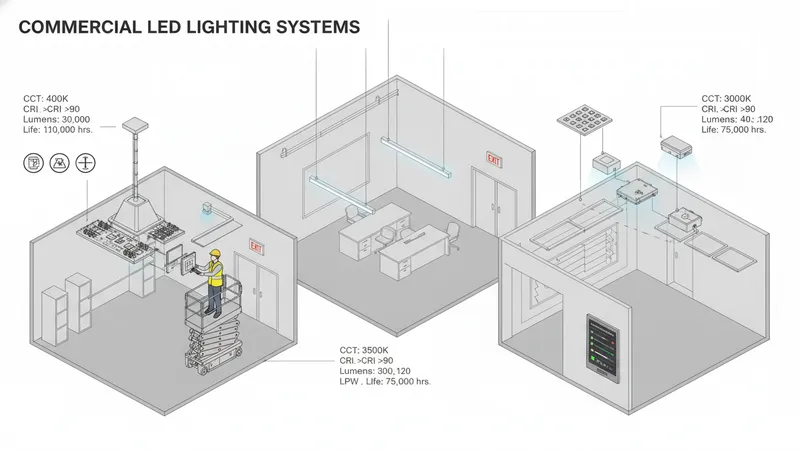
- Troffer and recessed panel fixtures: flat, ceiling-mounted luminaires commonly used in office and educational interiors; designed for uniform distribution and compatibility with grid ceilings.
- High-bay and low-bay LED fixtures: suspended or surface-mounted luminaires intended for warehouses, manufacturing floors, and gymnasiums where mounting heights and beam control matter.
- Linear, track, and accent LED systems: modular strips and track-mounted heads used in retail and display settings for flexible directional lighting and visual merchandising.
Performance metrics such as lumen output, luminous efficacy, and CRI provide a common basis for comparing fixture options. Lumen output measures total visible light, while efficacy relates output to electrical input and therefore can indicate relative energy consumption. CRI describes how accurately a light source renders colors compared with a reference; many commercial settings may prefer CRI values that support accurate color recognition without implying a single universal target. CCT often ranges from cooler tones for task-focused areas to warmer tones for customer-facing or hospitality-adjacent zones.
Fixture selection is also shaped by mounting geometry and space constraints. Recessed troffers may be chosen for existing suspended ceilings to achieve uniform ambient illumination, while high-bay fixtures with narrow or wide beam optics may be preferred at greater ceiling heights to control glare and aisle illumination in warehousing. Linear systems can be continuous-run or modular; they often permit targeted accenting of displays. Each type may integrate optic choices such as diffusers, lenses, or reflectors to shape light distribution for the intended application.
Controls and system integration are increasingly central to commercial LED deployments. Dimming protocols (e.g., 0–10V, DALI) and networked control platforms may be specified to enable daylight harvesting, occupancy-based reduction, or scheduled dimming. Such features can influence system complexity, initial configuration time, and interoperability with building management systems. When controls are present, designers often plan for commissioning and occasional recalibration to maintain expected performance over the system life.
Maintenance planning typically addresses driver replacement, thermal stress mitigation, and fixture cleaning. LEDs themselves may exhibit long rated lifespans, but ancillary components such as drivers, connectors, or lenses can require periodic attention. Access for service, clear documentation, and a maintenance schedule that considers operating hours and environmental factors (dust, humidity, heat) may help maintain consistent photometric performance. For larger installations, asset tagging and facility records often aid lifecycle tracking and phased upgrades.
In summary, commercial LED systems encompass a range of fixture types, performance metrics, and integration options suited to different business spaces. Selection involves balancing light quality, distribution, energy use, installation constraints, and serviceability. The next sections examine practical components and considerations in more detail.