
Healthcare Revenue Cycle Management: Key Software Features For Hospitals And Clinics

Feature categories in healthcare revenue cycle management software
Registration and front-desk features typically form the entry point for RCM workflows. These components often handle demographic capture, scheduling, insurance plan identification, and upfront estimates. In many settings, eligibility verification APIs or batch checks may be used to confirm coverage before services are rendered. Attention to data validation at this stage may reduce downstream claim rejections related to incorrect subscriber information or coordination-of-benefits errors. Organizations commonly configure alerts and verification steps to align with their patient volume and payer mix.
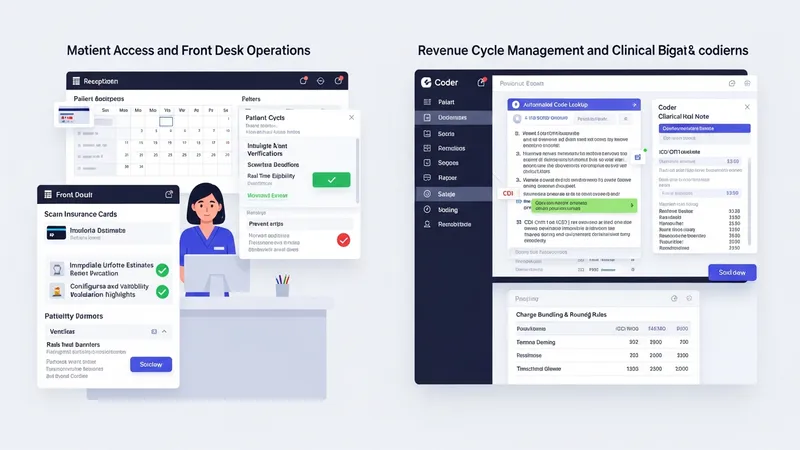
Coding and charge capture modules focus on translating clinical activity into billable items. These modules may support code lookup for widely used code sets, automated mapping from procedure or diagnosis documentation, and charge rounding or bundling rules. Some systems include clinical documentation improvement (CDI) prompts that may help coders align notes with appropriate codes. Accurate charge capture often relies on timely clinician documentation and periodic updates to code lists and pricing tables to reflect contractual or regulatory changes.
Claims management features typically include claim assembly, scrubbing, electronic submission (EDI), and payment adjudication tracking. Scrubbers run rules to identify formatting errors, missing provider identifiers, or code conflicts that often result in denials. After submission, remittance and explanation of benefits (EOB) processing may be automated so that payment posting can occur more quickly. Reconciliation processes compare expected reimbursement to received amounts, and adjustments or write-offs are recorded according to organizational policies.
Payment posting and patient billing components manage remit posting, patient statements, and collection workflows. Systems often support multiple posting methods, including electronic remittance advice (ERA) imports and manual entry. Patient balance estimation and itemized statements may be generated to clarify charges and payments. Where available, secure patient payment portals and integration with third-party payment processors can support electronic payments; configuration choices typically reflect institutional billing policies and consent procedures.