
Heating Element Manufacturers: Key Production Processes And Industry Standards

Fabrication Methods and Assembly Processes Used by Heating Element Manufacturers
Common fabrication methods include winding resistance wire on mandrels, inserting wire into ceramic tubes, compacting magnesium oxide into metal sheaths, and applying coatings to form infrared emitters. Each method has process-critical steps: control of winding tension and pitch for coils, particulate control and compaction pressure for MgO-filled tubular elements, and atmosphere control during high-temperature sintering where ceramic components are used. These variables can influence both short-term functionality and long-term stability. Production equipment may be configured for batch or continuous processing depending on volume and geometric consistency requirements.
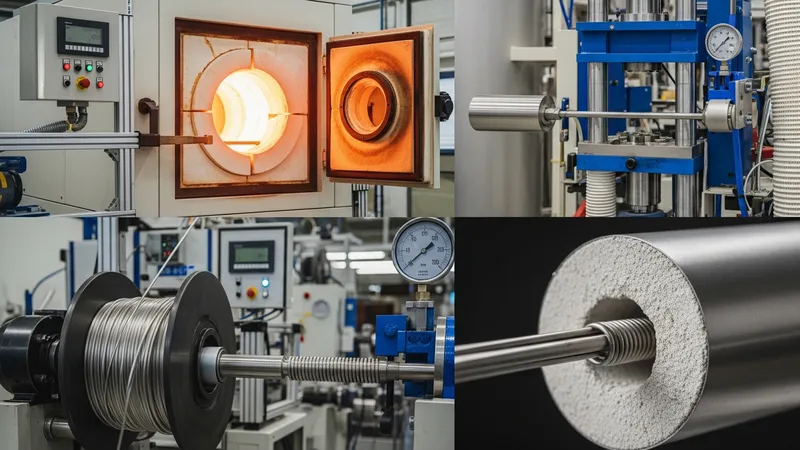
Joining and termination processes connect resistive paths to external leads and mounting hardware. Techniques such as laser welding, TIG welding, brazing, and mechanical crimping are used according to materials and temperature limits. Sealing and insulation around terminals may use high-temperature ceramics, mica, or specialized epoxies rated for the operating environment. Fixture design for consistent weld penetration or braze flow is often a key quality driver; manufacturers typically document parameters like heat input and filler materials to maintain reproducibility across shifts and machines.
Automation is increasingly applied to improve repeatability for high-volume product lines. Automated winding stations with tension control, robotic insertion for ceramic cores, and inline testing reduce manual variation. For low-volume or highly customized parts, skilled manual assembly remains common, particularly for complex terminations or when visual inspection is essential. Process control charts and first-article inspection methods are often used to bridge automated and manual operations, helping to detect drift and enabling corrective actions before full production continues.
Manufacturers commonly track yield influencers such as contamination during MgO packing, incomplete seals at terminations, or variations in wire resistance from different suppliers. Mitigation strategies may include tighter incoming material inspection, environmental controls for humidity and particulate, and statistical process control for critical dimensions. Engineers may recommend production trials that simulate expected duty cycles to validate assembly choices before scaling to larger batches, recognizing that accelerated tests may only approximate long-term in-service conditions.