
Pension Options For Seniors: Understanding Key Retirement Income Choices

Retirement income planning for older adults involves understanding the different mechanisms that can deliver money after regular employment ends. This concept covers publicly administered pensions, employer-sponsored plans, private savings and income-conversion products that provide periodic payments. The focus is on how these sources generate ongoing cash flow, how they interact, and how choices about timing and payout style can affect the amount and duration of income available during retirement.
Key aspects include eligibility rules, the method used to calculate benefits, payment frequency and flexibility, and the potential tax implications that apply to each source. Planning typically considers both predictable, contractually defined payments and more flexible arrangements where account balances are drawn down over time. The goal of examining these elements is to clarify trade-offs between steady income, liquidity, and potential longevity exposure.
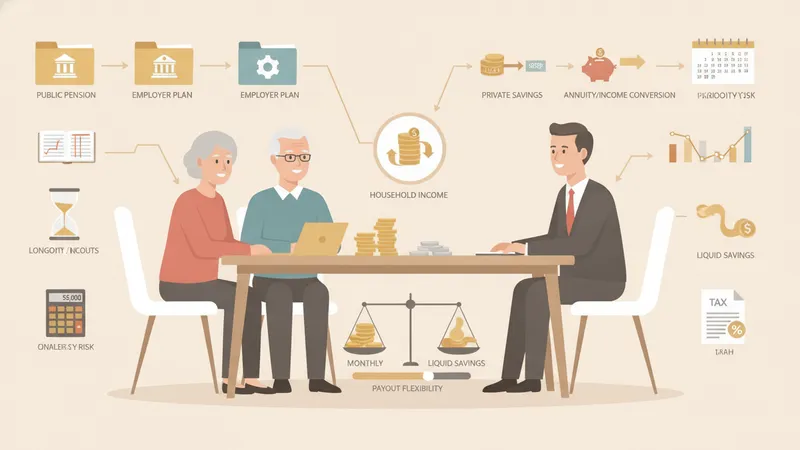
- Public or state pension systems — government-administered schemes that often provide lifetime payments based on work history or residency; benefit formulas may use earnings history and years of coverage. OECD on pensions
- Occupational plans — employer-sponsored arrangements, commonly divided into defined benefit (DB) plans with formulaic payouts and defined contribution (DC) plans where account balances are invested and later converted to income; plan rules determine vesting and payout options. ILO overview
- Personal retirement savings and drawdown strategies — individual accounts and pooled investments that retirees may withdraw from periodically; withdrawal sequencing and longevity considerations can influence sustainability.
- Annuity and income-conversion products — insurance or pooled arrangements that may provide a lifetime income stream in exchange for a premium or partial account transfer; product features and pricing can vary by issuer and jurisdiction.
Comparing these sources involves examining predictability, flexibility, and exposure to market and longevity risk. Public pensions and defined benefit occupational plans typically offer predictable periodic payments but may have eligibility or indexation constraints. Defined contribution accounts and personal savings provide flexibility in timing and amounts withdrawn yet are subject to market fluctuations and require planning to avoid exhausting resources prematurely. Annuity-type conversions can trade liquidity for longevity protection, which some people may value depending on other income sources.
Eligibility and payout timing often influence retirement strategy. Age-based eligibility, vesting schedules, and early-retirement reductions can materially change expected income flows. For account-based plans, the timing of withdrawals may interact with tax rules or required minimum distributions in some jurisdictions. Individuals may therefore weigh the immediate income benefit of earlier payments against the potential for larger later payments or different survivor provisions if deferral is permitted.
Benefit calculations typically rely on a formula for DB plans (for example, years of service times a multiplier times final salary) or on the accumulated balance for DC plans. For annuities, pricing reflects assumptions about longevity, interest rates, and administrative costs. Because underlying assumptions and methods vary, it can be useful to compare estimated periodic payouts under different conversion choices without assuming one option is universally preferable.
Tax treatment and interaction among income sources can affect net retirement income. Some pensions may be taxable, some partially exempt, and some withdrawals from savings may be taxed differently depending on account type and local rules. These distinctions often influence when income is taken and how different sources are sequenced. Considering potential taxation effects may help in understanding net cash flow rather than gross payouts alone.
In summary, older-adult income choices typically involve trade-offs among predictability, flexibility, and longevity protection. Reviewing public pensions, occupational plans, private accounts, and income-conversion products in the context of eligibility, payout mechanics, and tax treatment can clarify which combinations may meet different needs. The next sections examine practical components and considerations in more detail.