
Roof Repair: Identifying Common Roofing Problems And Early Warning Signs

Assessing roofing systems for damage involves recognizing common failure modes and the early indicators that a roof may be losing its ability to shed water, resist wind, or support loads. This process typically includes visual checks at the roof surface and in the attic, attention to visible materials such as shingles and flashing, and observation of building interior signs like ceiling stains. Understanding the typical progression of problems—small defects that can widen over time—helps frame inspection priorities and informs decisions about appropriate corrective measures without implying a single fixed solution.
Early detection often focuses on a combination of surface-level observations and diagnostic testing. Surface observations can reveal loose, missing, or curled shingles, rusted or displaced flashing, and debris accumulation in valleys and drains. Diagnostic approaches may include measuring moisture beneath roof membranes, thermographic imaging to show temperature differentials that suggest wet areas, and routine attic inspections to spot insulation or ventilation issues. These approaches are complementary and may be applied together to form a clearer picture of roof condition and likely causes of visible symptoms.
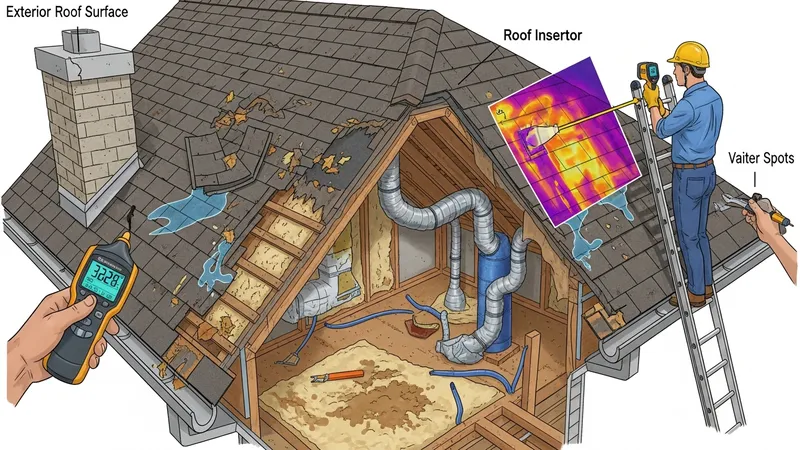
- Visual roof inspection: systematic walk-around and close-up checks of shingles, flashing, gutters, and roof penetrations; useful for detecting displaced materials and obvious deterioration.
- Infrared thermography: non-invasive imaging that can reveal thermal anomalies related to trapped moisture or insulation gaps; often used for complex roof membranes or large commercial roofs.
- Moisture metering and attic inspection: direct measurement tools and internal access checks that can confirm water intrusion and locate wet insulation, stains, or mold growth indicators.
Comparing inspection approaches shows they often serve different roles. Visual inspections typically identify obvious defects such as missing shingles or damaged flashing and can be conducted seasonally. Infrared thermography may be used when visual signs are absent but moisture is suspected; it can highlight temperature differences that often correlate with wet areas beneath roofing layers. Moisture meters and attic inspections provide point verification of wetness and can help determine whether staining on ceilings is active leakage or historical. Together, these methods can form a layered diagnostic strategy without claiming uniform applicability across all roof types.
Many common roofing problems follow recognizable patterns. For example, shingle deterioration can progress from granule loss to cracking and eventual displacement, while flashing failures often originate at penetrations such as vents and chimneys. Ponding water can accelerate membrane breakdown on low-slope roofs and may coincide with clogged drains or insufficient slope. Ventilation deficiencies can lead to condensation in attics, which typically shows as dark stains or insulation compaction. Not every visible symptom indicates immediate structural failure, but patterns of change over time may point to accelerating deterioration that could warrant targeted intervention.
Inspection frequency and documentation are practical considerations that may affect long-term outcomes. Regular seasonal checks—after winter and late summer, for instance—can reveal storm-related damage or progressive wear. Recording findings with photographs and dated notes helps establish trends, such as recurring leaks at the same location or gradual shingle uplift. Documentation can also support decisions about repair scope, whether spot repairs of flashing and shingles or broader membrane replacement. These records may be useful for facility managers and homeowners seeking to monitor changes objectively rather than relying on single observations.
Material type and roof age often influence the kinds of warning signs that appear. Asphalt shingles may show curled edges and granule loss as they age, while metal roofs can present corrosion or seam separation. Built-up and single-ply membranes on low-slope roofs tend to reveal issues as blisters, punctures, or seam failures. Recognizing typical failure modes by material can guide inspectors toward the most likely sources of leaks or damage, though combination roofs and layered assemblies may require multiple diagnostic techniques to identify concealed deterioration accurately.
In summary, a structured approach to roof assessment combines surface observation, targeted diagnostics, and consistent documentation to identify common problems and early warning signs. Visual inspections, infrared imaging, and moisture metering each provide different kinds of evidence that may be used together to form a clearer assessment. By noting patterns such as shingle degradation, flashing displacement, ponding, and attic condensation, observers can prioritize areas for closer investigation. The next sections examine practical components and considerations in more detail.