
Sage Accounts Payable Automation: Understanding Key Features And Workflow Capabilities

Accounts payable automation within a Sage environment refers to software-managed processes that reduce manual handling of supplier invoices and related payments. The concept centers on transforming paper or emailed invoices into structured digital records, applying predefined business rules, and routing documents through approval steps. Automation components commonly include capture technologies, validation checks, workflow orchestration, and transactional posting to the general ledger. The aim is to streamline routine processing while preserving an audit trail and supporting controls for spend verification and compliance.
In practice, these systems may combine optical character recognition (OCR) or machine learning for data capture, configurable routing for approvers, and rules for matching invoices to purchase orders and receipts. They typically produce reports that assist with cashflow planning and month-end reconciliation. Integration points are important: automated solutions often connect to financial ledgers, supplier master records, and banking interfaces so that invoice status, payment runs, and ledger entries remain synchronized.
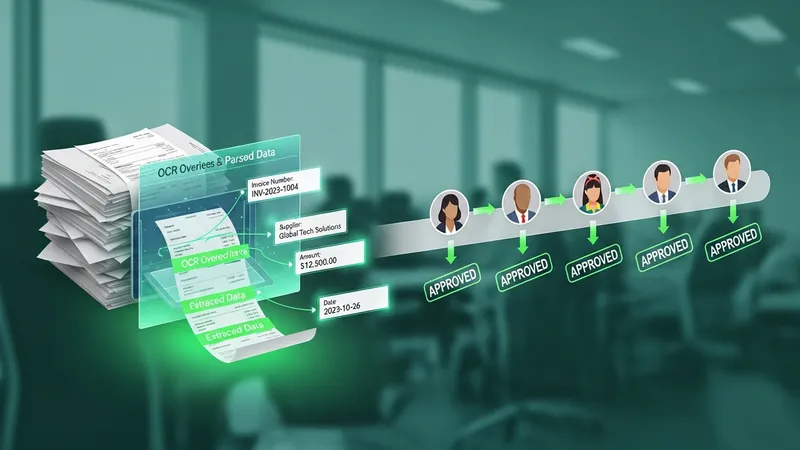
- Automated invoice capture and data extraction — methods that use OCR and rules-based parsing to convert invoice images or PDFs into structured fields for processing.
- Configurable approval workflows — role- and rule-based routing that can apply multi-step approvals, conditional escalation, and delegation for exceptions.
- Purchase order matching and exception handling — techniques for two-way or three-way matching that compare invoice details to orders and receipts and route mismatches to exception queues.
Invoice capture and extraction tools may vary in accuracy depending on document variability and language patterns; some implementations use supplemental validation rules or human review for high-exception volumes. When integrated with a Sage ledger, capture can populate supplier, date, amounts, and tax fields that later feed matching and approval steps. Accuracy on initial extraction often reduces manual correction, but projects typically plan for iterative tuning of parsing rules and template libraries to improve throughput.
Approval workflows can be designed around departmental roles, spend thresholds, and segregation-of-duties requirements. Workflows may include conditional branches where high-value or nonconforming invoices follow a different path than low-value routine ones. Auditability is typically improved because each action—submission, approval, rejection, or comment—is logged with timestamp and actor identity. Organizations often adopt configurable workflows that can be changed without code-level modification to reflect evolving policy.
Purchase order matching commonly uses two-way (invoice to PO) or three-way (invoice to PO and receipt) comparisons. Rules define allowable tolerances for quantity and price differences; invoices within tolerance may auto-approve while exceptions route to a human reviewer. Exception handling strategies often balance reducing manual work with preserving control: common practices include automatic suggestion of matching documents, supplier inquiry notes, and exception aging reports to track unresolved items.
Integration with payment processing and the general ledger typically involves mapping invoice, payment, and tax fields to ledger accounts, posting automated journal entries, and exporting payment files for banking systems. Payment automation may support different payment types and file formats and often includes a staging area for review before release. Reconciliation workflows may leverage remittance data and bank statements to close open items and update cash forecasts, with reporting that may inform working capital management.
Overall, the concept emphasizes reducing manual touchpoints while maintaining control, traceability, and integration with core financial systems. Implementation timelines and configuration needs can vary with invoice volume, supplier diversity, and existing system architecture; initial pilots often focus on high-volume, low-complexity suppliers to demonstrate process stability. The next sections examine practical components and considerations in more detail.