
Pharmacy POS Systems: How Integrated Software Supports Dispensing And Sales

Pharmacy point-of-sale (POS) systems combine retail checkout functions with pharmacy-specific dispensing tools to support both medication distribution and consumer sales. These systems typically link a sales register to prescription records, barcode scanning, inventory control, and payment processing so that front-end retail transactions and back-end dispensing tasks share a consistent data set. In neutral terms, an integrated pharmacy POS may coordinate prescription validation, price calculations, and cash or electronic payments alongside retail SKU sales, reducing duplicated data entry and helping staff access customer and medication information within a single interface.
Integration in pharmacy POS environments often includes connections to electronic prescribing, clinical decision support modules, and third-party reimbursement or claims gateways. Such links can streamline workflows by making insurance adjudication, refill authorizations, and labeling data more readily available at the point where a prescription is finalized. Integration may also permit consolidated reporting across retail and clinical functions, enabling pharmacies to reconcile sales, monitor controlled-substance dispensing patterns, and manage purchase orders for both over-the-counter and prescription stock from a unified system.
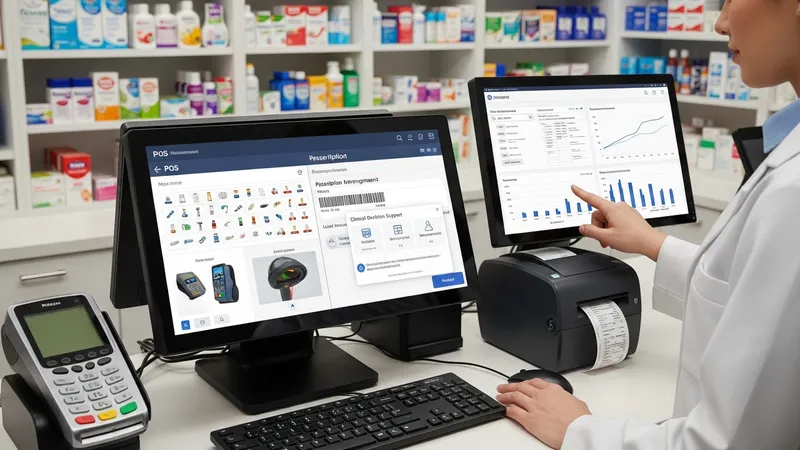
- Integrated dispensing module — A software component that stores prescription records, supports label printing, and tracks medication lot numbers; it typically interfaces with the POS register and may support barcode scanning for verification.
- Cloud-based inventory and retail POS — A centralized inventory service that synchronizes stock levels between dispensary shelves and the retail front-end in near real time, often accessible through web dashboards for purchasing and stock forecasting.
- E-prescribing and claims interface — A messaging interface that accepts electronic prescriptions and submits insurance claims or reversals to payers, helping reconcile payments and capture patient benefit information at the point of sale.
Pharmacy POS systems may differ by how they handle controlled-substance monitoring, automated refill workflows, and point-of-sale payment capture. Some systems include hardware support for barcode scanners and automated dispensing cabinets, while others emphasize cloud synchronization and remote access. When comparing functional areas, consider that inventory modules typically record batch and expiry data, payment modules handle tax and tender types, and dispensing modules must retain audit trails for regulatory compliance. These components often interact so that a sale transaction updates inventory quantities and the dispensing log simultaneously.
Reporting and analytics functions in pharmacy POS contexts often aggregate sales, dispensing counts, and inventory turnover metrics to support operational decisions. Reports may be scheduled to extract prescription fill histories, over-the-counter sales trends, and supplier order statuses. Where regulatory reporting is required, systems can often generate records suitable for audits, such as dispensing logs for controlled substances or payment reconciliation for insurance claims. Such outputs may be exported in common formats for review or archival purposes.
Security and access control are generally important in pharmacy POS environments because patient records and prescription histories contain sensitive information. Systems typically implement role-based permissions, user authentication, and audit logging so that staff actions are traceable and data exposure is limited to authorized personnel. Data protection measures may include encrypted storage and secure network communications to reduce the risk of unauthorized access while supporting legitimate dispensing and point-of-sale tasks.
Operationally, an integrated POS may influence pharmacy workflow design by consolidating tasks that were once split between separate retail and dispensing systems. For example, a single transaction can update a patient profile, decrement stock, record a prescription fill, and process payment in a sequential flow. Staff training and workflow mapping often accompany deployment so that pharmacists and technicians understand when to verify prescriptions, how to handle insurer rejections at checkout, and how to reconcile discrepancies between physical stock and system records.
In summary, pharmacy POS systems that integrate dispensing and retail sales functions aim to centralize data, reduce duplicate entry, and provide a consistent operational record across both clinical and retail activities. These systems may support inventory control, e-prescribing interfaces, payment processing, and reporting features that together help manage daily pharmacy operations. The next sections examine practical components and considerations in more detail.