
Rubber Mixer Machine: Overview Of Types, Components, And Applications

Industrial-scale equipment for blending elastomeric polymers with fillers, plasticizers, curatives, and other additives enables consistent compound preparation before shaping and curing. These machines vary by configuration and mixing action: some enclose rotating rotors inside a chamber to knead a batch, others use counter-rotating rolls on an open mill, and continuous lines combine shear and residence-time control. The principal objective of these systems is to distribute solid and liquid ingredients uniformly, control temperature and viscosity during processing, and deliver material in a form suitable for subsequent operations such as extrusion, calendering, or molding.
Design choices influence energy input, batch size, maintenance needs, and process repeatability. For example, enclosed batch mixers often allow tighter control of internal temperature and shorter residence times, while open mills permit visual inspection and manual adjustments during mixing. Continuous mixers may be used where steady throughput and narrow residence-time distribution are priorities. Selection typically involves trade-offs among material throughput, heat management, shear profile, and downstream compatibility, so understanding machine classes and operating parameters is essential for consistent compounding outcomes.
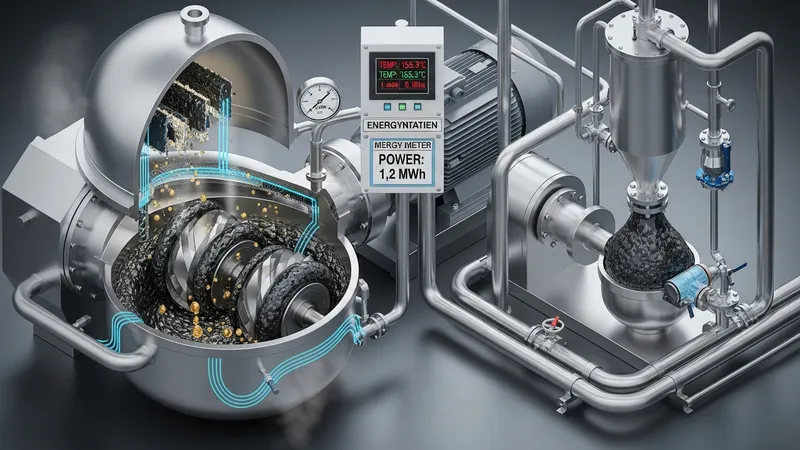
- Internal (Banbury-type) mixer — a closed-chamber, batch kneader that uses high-shear rotors for mixing dense compounds and often allows temperature and fill adjustments.
- Open two-roll mill — an exposed rolling system where operators fold and pass the rubber sheet between heated rolls for dispersion and tack control.
- Continuous high-shear mixer — a line-oriented unit where material residence time and shear rate are controlled to produce steady compound output for high-volume processes.
Comparing these machine types highlights typical trade-offs: enclosed batch mixers generally produce homogenous dispersion in smaller, controllable batches and may reduce operator exposure to airborne dust, while open mills can handle large sheets and facilitate visual inspection but may require more manual skill. Continuous mixers can improve throughput consistency and reduce per-unit handling, yet they often demand precise dosing and upstream feeding systems. Each configuration may be paired with different downstream handling equipment, and material formulation adjustments frequently accompany a change in mixing platform to maintain target compound properties.
Key process variables during mixing often include rotor speed, fill factor (volume occupied by compound versus chamber volume), cycle time, and specific energy input. Temperature control is critical because many additives activate or soften at elevated temperatures; systems may use water or oil cooling jackets, cooled rolls, and real-time sensing to maintain target ranges. Monitoring power draw and torque can indicate compound viscosity and dispersion progress: a rise or fall in power consumption may signal over- or under-mixing. These measurements typically inform process endpoints rather than absolute guarantees of performance.
Safety and maintenance aspects also shape equipment selection and layout. Enclosed mixers usually include interlocks, emergency stops, and specified lockout-tagout procedures to reduce entrapment risk, while open mills require barrier use and operator training to lower hazards associated with moving rolls. Scheduled maintenance of seals, rotor bearings, hydraulic systems, and drive components may extend service life and preserve mixing consistency. Maintenance planning often balances production continuity against the need for periodic shutdowns to inspect wear-sensitive parts.
Quality control in compounding typically involves sampling for dispersion tests, Mooney viscosity or cure rheometry, and dimensional checks after shaping. These analytical checks may be performed at set intervals or following process adjustments. Traceability of batch records, including ingredient lot numbers and mixer cycle parameters, can assist in root-cause analysis when deviations occur. The next sections examine practical components and considerations in more detail.