
Rubber Mixer Machine: Overview Of Types, Components, And Applications

Types of rubber mixing equipment and their characteristics
Batch internal mixers, open two-roll mills, and continuous mixers represent common families of rubber mixing equipment, each with distinct mechanical and thermal characteristics. Internal mixers use intermeshing rotors in a closed chamber to impart intensive shear; they may be equipped with ram systems to control fill and discharge. Two-roll mills rely on friction and folding actions between heated rolls to achieve dispersion, often used for small-scale or laboratory adjustments and for tack control before calendaring. Continuous mixers combine screw or rotor conveyance with controlled residence time, favoring steady production and integration with continuous downstream processes.
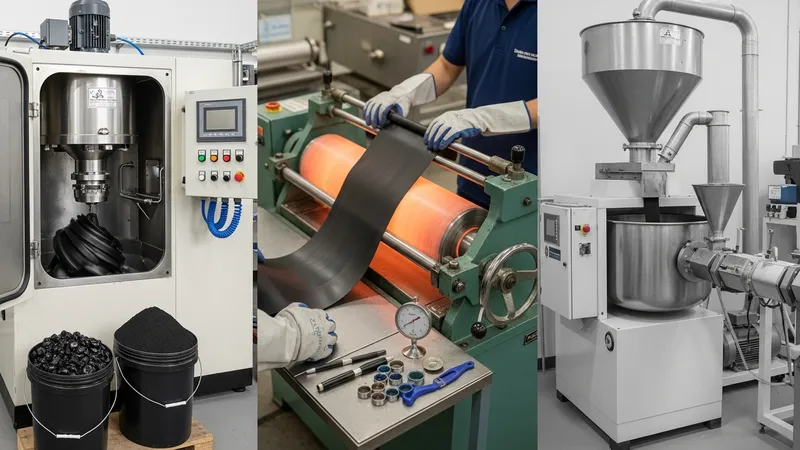
Typical considerations when choosing among these types include expected throughput, compound viscosity, heat sensitivity of additives, and the need for visual process intervention. For elastomers sensitive to temperature-induced reactions, enclosed mixers with robust cooling may help limit premature crosslinking. When formulations include large-volume fillers that require high mechanical energy to disperse, machines that can generate sufficient shear while avoiding excessive temperature rise are often selected. Cost, floor space, and operator skill also influence the practical choice of equipment.
Operationally, scaling a formulation between mixer types may require adjustments to fill factor, rotor speed, or blending sequence. For example, a compounding sequence developed on an open mill can often be translated to an internal mixer by altering the order and intensity of additions to achieve similar dispersion states. Continuous systems may demand reformulation to accommodate steady-state feeding and shear history. These translation considerations are non-prescriptive framing points that typically guide process development and laboratory-to-production scale-up.
Insider considerations often include the expected maintenance cadence for each machine type and the availability of replacement parts for wear-prone components such as rotor tips, roll covers, and seals. Noise, dust control, and local exhaust requirements can differ: enclosed mixers typically limit airborne particulate release, while open mills may require more extensive local ventilation. Factoring these operational elements into equipment selection may reduce downstream process interruptions and support more consistent compound characteristics over time.