
Wastewater Recycling: Key Processes And Treatment Stages Explained

The practice of treating used water so it can be reused involves a sequence of mechanical, biological and advanced physical-chemical operations. These stages aim to remove solids, reduce organic matter and control pathogens and nutrients so that effluent can meet intended reuse objectives. Typical systems combine preliminary screening, settling, biological processes, tertiary filtration and disinfection, with monitoring and sludge handling integrated throughout. The specific arrangement and intensity of treatment are matched to the source of the wastewater, the target water quality, and regulatory or operational constraints.
In operational terms, the workflow begins with capturing and coarse screening to protect downstream equipment, proceeds through primary settling to remove settleable material, and then uses biologically based reactors to break down dissolved organics. Secondary clarification separates biomass from treated liquor; tertiary steps polish the effluent to remove residual suspended solids, nutrients or micro-pollutants. Final disinfection addresses microbial quality before storage or distribution for reuse. Parallel processes for sludge management and routine monitoring support system reliability and compliance.
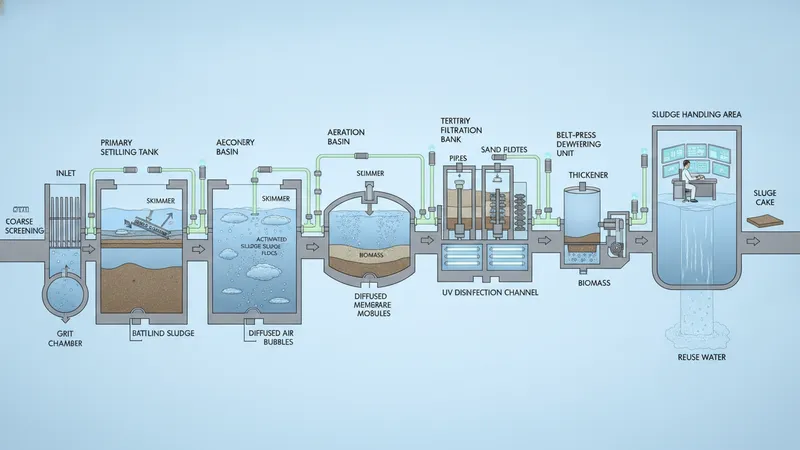
- Collection and screening methods — mechanical bars, comminutors and grit chambers used to remove coarse solids and protect pumps and subsequent units.
- Biological treatment approaches — suspended-growth systems (e.g., activated sludge) and attached-growth systems (e.g., trickling filters, moving-bed biofilm reactors) that metabolize organic matter and nitrogen compounds.
- Membrane and advanced filtration technologies — microfiltration, ultrafiltration and reverse osmosis used for fine particulate and dissolved constituent removal, often paired with chemical or UV disinfection.
Mechanical front-end processes commonly precede biological stages to limit abrasion and clogging. Screens and grit removal can often capture most large debris and heavy particles, reducing maintenance downstream. Flow equalization basins may be included to moderate hydraulic and organic load swings, which can improve biological performance. Design choices here are typically influenced by catchment characteristics, expected peak flows, and the availability of operator expertise to manage equipment such as bar screens and grit classifiers.
Primary sedimentation units are usually designed to settle heavier particulates while biological reactors target soluble and colloidal organics. Selection between activated sludge, biofilm reactors or hybrid systems often depends on space, energy considerations and nutrient removal needs. For nitrogen control, processes may incorporate aerobic nitrification followed by anoxic denitrification, which typically requires control of dissolved oxygen and retention times. Each biological approach may respond differently to temperature and influent variability, so operational flexibility is often incorporated.
Tertiary and advanced treatment steps are applied when higher-quality effluent is required for specific reuse applications. Filtration, chemical coagulation, nutrient removal and membrane separation can reduce turbidity, phosphorus, and micropollutants. Membrane systems may offer compact footprints but commonly require attention to fouling control and periodic cleaning. Disinfection methods such as ultraviolet irradiation or chlorine-based approaches are selected based on target microbial metrics and potential by-product considerations.
Effective reuse systems typically integrate water quality monitoring and a sludge management strategy. Monitoring programs frequently track parameters such as biochemical oxygen demand (BOD), total suspended solids (TSS), turbidity, nutrient concentrations and indicator organisms to verify performance. Sludge handling often involves thickening, stabilization (for example, anaerobic digestion), dewatering and further treatment or disposal. Decisions about sludge pathways may reflect local regulations, available infrastructure and resource recovery goals such as biogas production.
Overall, a treated-effluent reuse program is a sequence of complementary stages that together determine the suitability of reclaimed water for a range of applications. Trade-offs among capital cost, energy consumption, operational complexity and the intended reuse purpose are typically evaluated during planning and design. The next sections examine practical components and considerations in more detail.