
AI Medical Billing: How Automation May Streamline Claims Management

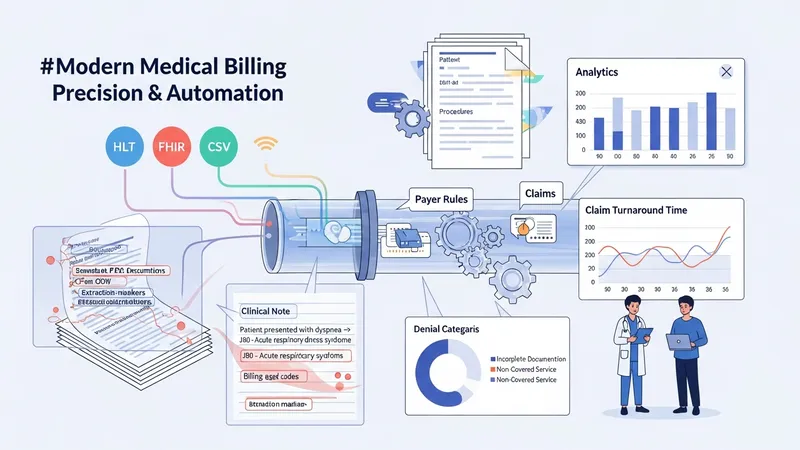
AI Medical Billing: How Automation May Streamline Claims Management — Core Automation Components
Core components of automated medical billing systems typically include data ingestion, transcription or OCR, NLP for clinical concept extraction, a rules engine for payer requirements, and analytics for monitoring. Data ingestion may accept HL7, FHIR, CSV exports, or direct database connections from an electronic health record; OCR may handle PDFs and scanned documents. NLP models can convert narrative notes into candidate codes or highlight documentation gaps. Rules engines often encode payer-specific logic, and analytics tools aggregate metrics such as claim turnaround times and common denial categories to guide optimization.
Optical character recognition and structured data feeds address different input types and often coexist. OCR is valuable for legacy or paper-driven workflows, while structured feeds from modern EHRs reduce the need for text extraction. When models rely on narrative interpretation, consistent documentation styles typically improve accuracy. Teams evaluating components commonly consider explainability, interoperability with existing software, and the ability to manage updates to payer rules without extensive reprogramming.
Machine learning components used for classification or prioritization usually require labeled training data drawn from prior claims and remittance outcomes. Model performance may vary by specialty and documentation style, so organizations commonly retrain or fine-tune models on local data. Where possible, retaining human review of uncertain classifications and maintaining audit logs for automated decisions supports oversight, troubleshooting, and compliance with data governance expectations.
When planning a deployment, stakeholders often weigh integration complexity, expected throughput gains, and ongoing maintenance needs. Practical considerations include the frequency of payer rule changes, availability of labeled historical data, and staff capacity to handle exceptions. Documenting these factors and establishing feedback loops between billing staff and system owners may help align automation behaviors with operational realities.