
AI Medical Billing: How Automation May Streamline Claims Management

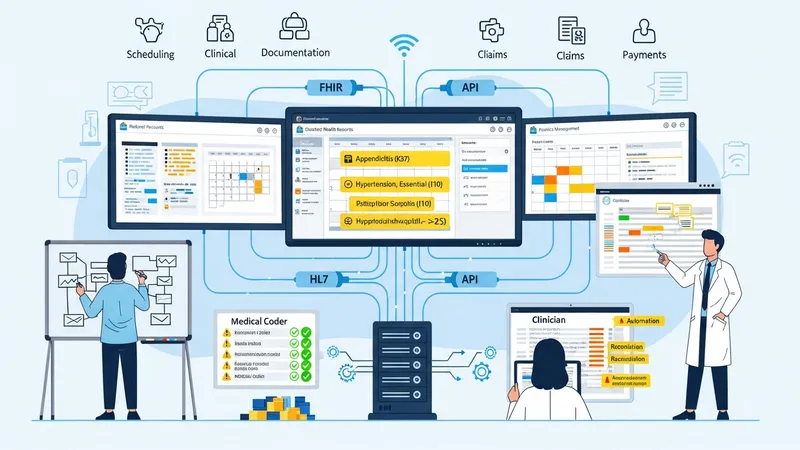
AI Medical Billing: How Automation May Streamline Claims Management — Workflow Integration and Data Exchange
Workflow integration commonly determines the practical impact of automation on claims management. Systems that connect directly to scheduling, clinical documentation, and practice management platforms can surface coding suggestions earlier in the encounter lifecycle, which may reduce post-encounter rework. Typical integrations use standard APIs or file-based exchanges; maintaining consistent identifiers across systems is essential for accurate linking of encounters, claims, and payments. Interoperability choices often affect latency, error rates, and the ease of reconciling automated outputs with human workflows.
Standards-based interfaces such as FHIR and HL7 may facilitate structured data exchange but are not universally implemented across all providers and vendors. Where standards are absent, organizations may rely on custom connectors or middleware, which can introduce maintenance overhead. Data normalization — aligning terminology, provider identifiers, and payer codes — often improves the reliability of automated processes. Teams may therefore allocate effort to mapping and transformation logic early in a deployment to reduce downstream mismatches.
Integration planning also involves designing exception workflows for claims that an automated process flags as uncertain or high risk. Typical patterns preserve human-in-the-loop review for these exceptions while allowing routine claims to flow through automated validation. Establishing clear escalation paths, assigning ownership for exception resolution, and maintaining traceable decision records help ensure that automated actions are auditable and that learning from resolved exceptions can be fed back into model tuning or rule updates.
Data governance considerations influence both integration and ongoing operation. Access controls, audit trails, and change-management processes for payer rules or model parameters are commonly part of implementation roadmaps. Organizations often find that balancing ease of integration with rigorous controls results in more sustainable automation, with documented interfaces and versioned rule sets supporting both efficiency and accountability.