
Air Pollution Monitors: How Sensors Track Particulate Matter And Gases

Air quality monitoring relies on instruments that quantify airborne particles and reactive gases. These instruments range from compact sensor modules to reference-grade samplers. Particle-detection components typically measure size-resolved concentrations by sensing light scattered by individual or aggregated particles, or by collecting particles onto filters for mass measurement. Gas-detection components may detect target molecules through chemical reactions, optical absorption, or ionization. Together, these systems translate physical or chemical interactions into electrical signals that represent pollutant concentrations over time. Data outputs often include time-stamped values, size fractions for particles, and indications of sensor status or uncertainty.
Routine monitoring systems integrate sensing elements with data acquisition, local processing, and networked transmission. Many monitors provide near real-time readings, while others operate on scheduled collection cycles for laboratory analysis. Calibration and quality assurance are commonly required to relate sensor signals to standard concentration units and to correct for environmental effects such as temperature and humidity. Applications span indoor air quality assessments, urban ambient networks, industrial emissions screening, and research studies that track temporal trends and source contributions without implying regulatory compliance by a single device.
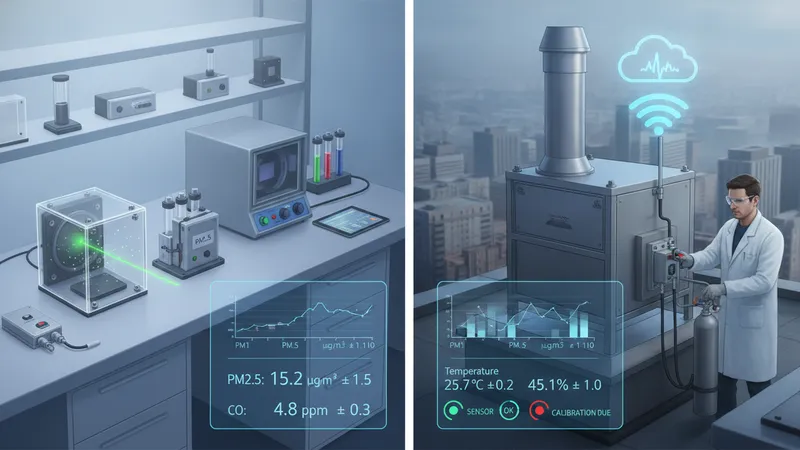
- Optical particle sensors (laser scattering): measure particle number and estimate mass for size fractions such as PM1, PM2.5, and PM10 by detecting light scattered from airborne particles; often used for continuous, real-time monitoring.
- Gravimetric samplers (filter-based reference methods): collect particles on filters for laboratory weighing and chemical analysis; often treated as reference standards for regulatory comparisons and calibration.
- Electrochemical and metal-oxide gas sensors: detect gases such as carbon monoxide, nitrogen dioxide, ozone, and volatile organic compounds by chemical or surface-reaction mechanisms; typically compact and used in networks or portable devices.
Optical particle sensors and gravimetric samplers represent different trade-offs. Optical sensors can provide high temporal resolution and lower operational cost but may be influenced by particle composition, humidity, and coincidence errors at high concentrations. Gravimetric methods provide direct mass measurements and support chemical speciation but require laboratory processing and time. When both approaches are used together, optical data often serves as a continuous proxy that may be calibrated against periodic gravimetric results to improve long-term accuracy and comparability across sites.
Gas detection technologies vary by principle and target compound. Electrochemical cells can exhibit cross-sensitivity where one gas produces a signal similar to another; metal-oxide sensors may change baseline with temperature and require conditioning. Optical methods such as nondispersive infrared (NDIR) or ultraviolet absorption are often applied to stable gases like carbon dioxide or ozone and may offer greater selectivity. Photoionization detectors (PIDs) can measure a broad set of volatile organic compounds but typically report in terms of total ionizable compounds rather than species-specific concentrations.
Data collection and processing choices influence how pollution trends are interpreted. Short-term spikes detected by a sensor may reflect transient sources such as combustion events, while longer-term averages can indicate background levels. Typical monitoring systems include onboard filtering, averaging, or flagging routines to identify outliers and sensor drift. Metadata that records calibration dates, environmental conditions, and sensor diagnostics may improve post-processing and comparability across instruments. Analysts often apply uncertainty estimates rather than single-value declarations to convey confidence in reported concentrations.
Common limitations of low-cost and compact monitors include sensitivity to environmental factors, sensor aging, and limited chemical selectivity. Many networks use reference-grade samplers at key sites to anchor broader sensor networks. Integrating multiple sensor types—particle counters with gas sensors and meteorological instruments—can aid source attribution by correlating pollutant patterns with wind, temperature, or human activity cycles. Such multi-parameter approaches typically increase interpretability while requiring careful data harmonization.
In summary, monitoring ambient and indoor pollutants relies on a combination of particle and gas sensing methods that trade temporal resolution, selectivity, and operational complexity. Optical particle counters, gravimetric samplers, and electrochemical gas sensors illustrate common approaches; each may be used alone or together depending on monitoring goals. Calibration, environmental corrections, and metadata practices often determine the usability of measurements for assessment or research. The next sections examine practical components and considerations in more detail.