
Air Pollution Monitors: How Sensors Track Particulate Matter And Gases

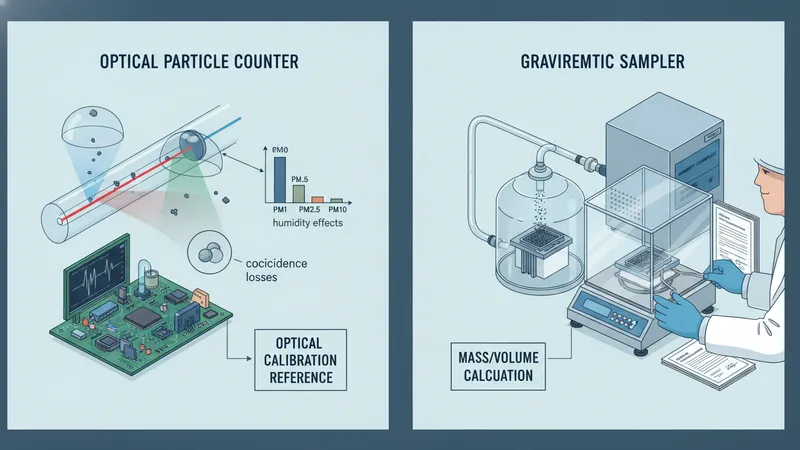
Sensor types and measurement principles for particulate detection
Optical particle counters use light scattering to detect individual particles and classify them by size bins. Their electronics count pulses corresponding to scattering events and estimate mass concentrations through conversion factors that assume particle density and shape. These instruments typically report size-resolved number concentrations and derived mass for PM1, PM2.5, and PM10 fractions. Considerations include coincidence losses when particle concentrations are high, interference from high relative humidity that alters scattering, and the need for periodic calibration against gravimetric filters to adjust sizing and mass-conversion coefficients for local aerosol composition.
Gravimetric samplers collect particles on pre-weighed filters using controlled flow. After sampling, filters are conditioned and weighed in a laboratory balance to determine mass per unit air volume. This direct mass approach is widely used as a reference measurement because it does not rely on optical assumptions; however, it requires careful handling, controlled humidity during conditioning, and staff time. Gravimetric results often serve as calibration anchors or verification points for continuous optical sensors in monitoring programs where traceable mass measurements are important.
Optical instruments may be supplemented by condensation particle counters (CPCs) when ultrafine particle number concentrations are of interest. CPCs grow small particles using a working fluid and then count them optically, providing high sensitivity to submicron particles that may be missed by size-limited counters. While CPCs offer valuable information about number concentrations and nucleation events, they can be bulkier and require maintenance. Combining CPC outputs with mass-based measurements can help characterize particle size distributions and infer likely sources.
When selecting particulate monitoring approaches for a study or network, factors to weigh include temporal resolution needs, required size fractions, resource availability for laboratory analysis, and environmental conditions at the site. Field programs often pair continuous optical monitors with periodic gravimetric sampling and meteorological observations. Such hybrid designs allow continuous trend detection while retaining periodic reference-quality checks to account for environmental influences and sensor drift. These choices may vary with the monitoring objectives rather than being universally prescriptive.