
Air Pollution Monitors: How Sensors Track Particulate Matter And Gases

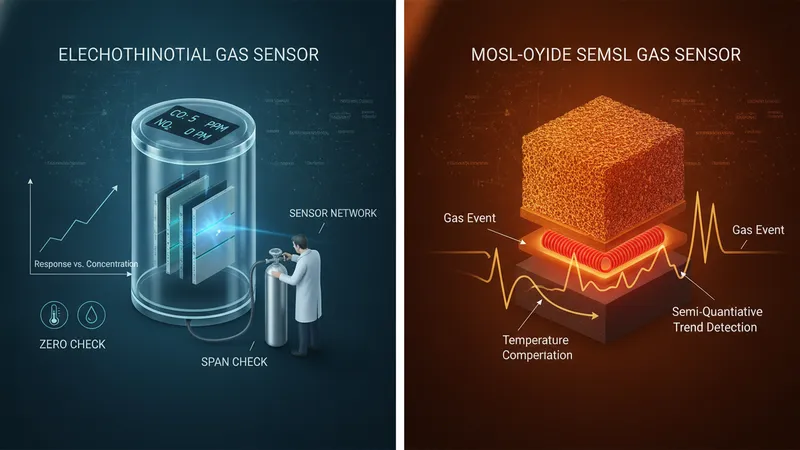
Gas sensor classes and practical considerations for monitoring gases
Electrochemical sensors operate by generating an electrical current when a target gas reacts at an electrode; the signal is proportional to concentration within a working range. These sensors are compact and commonly used for gases such as carbon monoxide (CO) and nitrogen dioxide (NO2). Performance is sensitive to temperature, humidity, and cross-sensitivity to interfering gases; periodic calibration against known gas concentrations is often necessary to maintain quantitative accuracy. In network deployments, routine zero and span checks can help identify drift and maintain data quality over time.
Metal-oxide-semiconductor (MOS) sensors detect gases by changes in surface conductivity when gas molecules interact with a heated sensing layer. MOS devices are durable and inexpensive but typically provide semi-quantitative responses that vary with temperature and baseline condition. They can be informative for detecting relative changes or event detection rather than precise absolute concentrations. Careful baseline characterization and temperature compensation strategies can improve MOS utility for trend detection and screening applications.
Optical gas sensing methods such as nondispersive infrared (NDIR) and ultraviolet (UV) absorption provide selectivity for particular molecular bonds and are often used for gases like carbon dioxide (CO2), carbon monoxide, and ozone. These instruments may be larger and more power-intensive but can deliver stable responses with lower cross-sensitivity than some electrochemical types. Photoionization detectors (PIDs) can detect a wide range of volatile organic compounds but typically report a summed response, so they are most useful where total volatile load rather than species-specific concentration is the target.
Choosing gas sensor technologies depends on monitoring goals and ambient conditions. For long-term trend analysis, instruments with stable baselines and documented calibration procedures are typically preferred; for portable screening, compact electrochemical or MOS sensors may be acceptable to identify areas for further study. Combining sensor types and including meteorological data can improve source attribution. These are considerations rather than prescriptive rules, and selection should match the intended measurement quality and logistical constraints.