
Applicant Tracking System: Key Features, Functions, And Use Cases

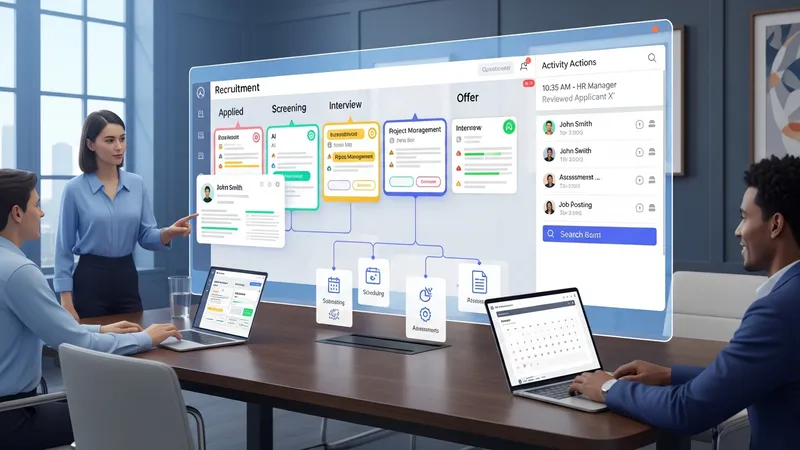
An applicant tracking platform is software that centralizes candidate information and coordinates recruitment-related tasks across an organization. Typical capabilities include intake of position postings, parsing of resumes and applications, maintenance of candidate pipelines, and tools for scheduling interviews and assessments. These platforms often provide role-based access, activity logs, and searchable records so teams can manage multiple openings and candidate interactions without relying on isolated spreadsheets or email threads.
Such systems usually integrate with external services and internal tooling to reduce manual work. Common integration points are resume parsing engines, calendar services for interview coordination, assessment providers for technical screening, and external posting or distribution connectors for broadcasting positions to multiple channels. Reporting modules often summarize time-to-fill, source effectiveness, and pipeline bottlenecks so stakeholders can interpret process performance without direct involvement in day-to-day candidate handling.
- Resume parsing engines — software components that extract structured data (contact details, experience, education) from uploaded documents; examples include Sovren and RChilli as widely referenced parsing providers.
- Position distribution connectors — services that automate sharing position descriptions to multiple listing destinations and aggregators; examples include Broadbean and eQuest as representative distribution tools.
- Interview scheduling and assessment integrations — calendar and assessment tools that connect to candidate records to coordinate availability and scoring; examples include Calendly for scheduling and HackerRank for technical assessments.
One common comparison is between systems focused on core applicant intake and those offering broader human-resources workflow coverage. Core intake platforms typically emphasize parsing accuracy, candidate search, and pipeline visualization, while more expansive suites may add onboarding, offer letter generation, and extended HR integrations. Organizations often assess trade-offs in deployment complexity and feature scope; a focused intake platform may require fewer integrations, whereas a broader suite may reduce the need for separate third-party tools but can increase configuration and training effort.
Resume parsing quality and tagging conventions can materially affect later stages of selection. Parsing engines may differ in how they handle multi-page formats, nonstandard section headings, and international date formats; this can influence automated screening and keyword matching. Data cleanliness measures such as consistent field mapping, duplicate detection, and manual review workflows are often adopted to reduce false negatives and ensure that candidate profiles remain useful for search and shortlisting across multiple positions.
Automation of routine tasks often concentrates on repetitive actions such as status updates, interview reminders, and candidate communications. Automated workflows may trigger a sequence when a candidate reaches a specific stage (for example, sending an assessment link or requesting references), which can shorten administrative cycles. Careful design is typically recommended: overly broad automation can create candidate experience issues, whereas targeted automation may preserve human oversight for higher-sensitivity interactions such as offer negotiation or final references.
Reporting and analytics within these platforms tend to cover funnel metrics, sourcing effectiveness, and time-related signals. Typical dashboards provide metrics like time at stage, candidate throughput, and source attribution so teams can identify bottlenecks and evaluate external posting channels. Metrics are often presented with filters for team, hiring manager, or position type to support more granular analysis; cautionary practices include confirming data completeness and avoiding conclusions from small sample sizes.
In summary, candidate management platforms centralize application intake, candidate records, and process automation while integrating with parsing, scheduling, and assessment tools. Key distinctions between offerings often relate to parsing accuracy, breadth of workflow coverage, and reporting depth. Selection typically involves trade-offs among ease of configuration, integration requirements, and desired automation levels. The next sections examine practical components and considerations in more detail.