
CAASM: Understanding Cyber Asset Attack Surface Management Fundamentals

Asset Discovery Methods in CAASM
Asset discovery methods in CAASM commonly fall into complementary categories that together improve coverage. Agent-based collection may provide granular host and application data and typically enables richer telemetry per endpoint. API-based collection from cloud providers often yields resource metadata such as instance identifiers, service configurations, and role bindings, which can inform cloud exposure analysis. Passive network techniques can reveal ephemeral or unmanaged devices that do not host agents. Combining these approaches can often reduce blind spots, while organizations should consider trade-offs related to deployment overhead, data volume, and privacy constraints when selecting discovery methods.
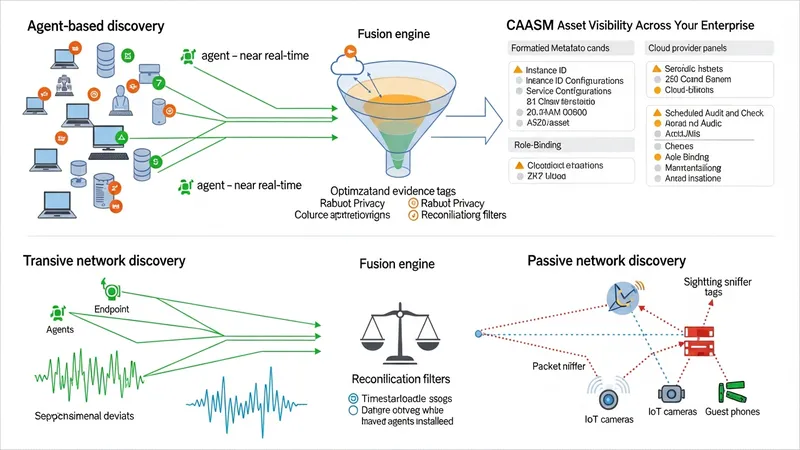
When choosing discovery mixes, an important consideration is data freshness and synchronization cadence. Agent telemetry may be near real-time for active hosts, while cloud APIs may reflect eventual consistency and periodic updates. Passive network observations can be transient and require correlation with additional sources to avoid false positives. Organizations often maintain timestamped evidence and source attribution for each discovered attribute so that consumers can assess recency. Planning for reconciliation rules and deduplication logic often reduces noise and supports clearer asset lineage for later analysis.
Operational constraints such as segmented networks, intermittent connectivity, and remote or IoT devices can affect discovery effectiveness. In such contexts, passive or network-based discovery can surface devices that are not reachable by agents, while periodic endpoint sweeps or jump-host approaches may be used to augment coverage. Privacy, compliance, and data minimization considerations can restrict certain collection techniques; documenting acceptable collection scopes and retention periods often helps balance visibility against policy requirements. These operational details commonly inform phased deployment strategies for CAASM.
As discovery feeds accumulate, consideration of asset classification becomes important for downstream use. Classifying assets by environment, criticality, exposure (e.g., internet-facing), and ownership can help prioritize review efforts. Many organizations adopt simple classifications initially and refine categories over time as more contextual data becomes available. Clear tagging conventions and alignment with existing inventory or CMDB structures can reduce friction between CAASM outputs and other operational systems, often making integration smoother.