
CAASM: Understanding Cyber Asset Attack Surface Management Fundamentals

Inventory Normalization and Data Modeling in CAASM
Inventory normalization converts heterogeneous asset records into a consistent schema that can be queried and linked. Sources often use different identifiers—IP addresses, hostnames, instance IDs, or UUIDs—and normalization may apply deterministic joins or probabilistic matching to correlate records. Data models that include attributes, relationships, provenance, and confidence scores can make inventories more useful for analysts. Graph-oriented models frequently represent relationships explicitly, enabling queries that traverse identity-to-resource or service-to-host connections and supporting impact analysis during incident response scenarios.
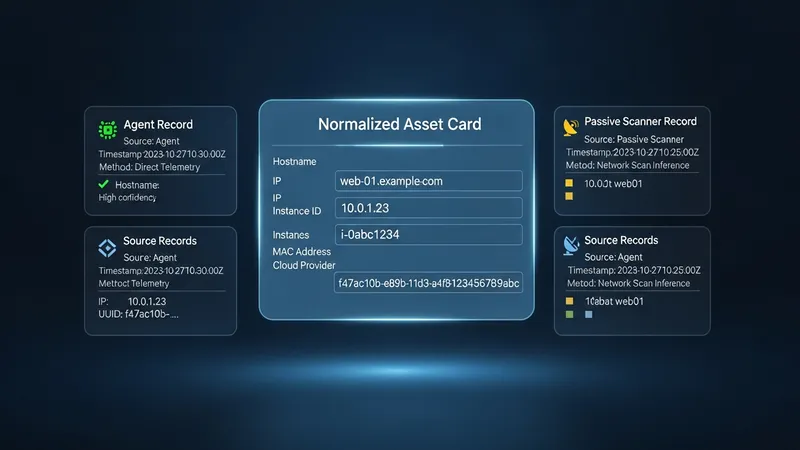
Provenance metadata is an important component of normalization workflows. Recording the original source, collection timestamp, and method of inference helps downstream users assess reliability. Confidence scoring can be applied when data is merged from conflicting sources; for example, agent data may be assigned higher confidence for local configuration items, while passive discovery may carry moderate confidence for service presence. These design choices often depend on threat model priorities and available validation mechanisms.
Duplicate detection and lifecycle handling prevent inventory bloat and stale records. Implementing rules for merging records, deactivating assets that have not been seen for defined intervals, and archiving historical snapshots can maintain operational clarity. Versioning of asset records may support temporal queries, such as determining the configuration state at a specific point in time for forensic or compliance purposes. These practices typically improve the utility of a CAASM inventory as a source of truth.
Interoperability with other data sources often requires standardized formats or connector frameworks. Exporting normalized asset data via APIs, message queues, or file exports enables downstream systems—vulnerability scanners, SIEMs, or IT service management platforms—to consume consistent information. Defining clear API contracts and minimal viable schemas can help integration efforts scale. Considerations such as rate limits, authentication, and access control should be treated as part of the normalization and distribution design to maintain operational reliability.