
Conveyor Systems Manufacturers: Key Considerations When Selecting Industrial Suppliers

Selecting an industrial supplier for conveyor equipment involves a technical evaluation of products and services that support material movement in manufacturing or distribution. This concept covers assessment of physical system designs, expected load profiles, material contact compatibility, control and automation capabilities, and the supplier’s capacity to provide engineering support. Attention is often given to installation services, spare parts availability, maintenance offerings, and alignment with relevant industry standards. The process typically balances immediate functional needs with projected operational life and adaptability to changing production requirements.
Comparisons among conveyor equipment suppliers commonly consider both product attributes and service scope. Technical criteria may include belt or chain types, frame materials, drive arrangements, and modularity. Service criteria often address delivery timelines, on-site assembly, commissioning support, training, and warranty terms. Procurement teams may use formal requests for information or proposals and may request factory acceptance testing or on-site demonstrations to verify performance under representative conditions. Financial factors such as total cost of ownership can be part of the evaluation without implying predictable outcomes.
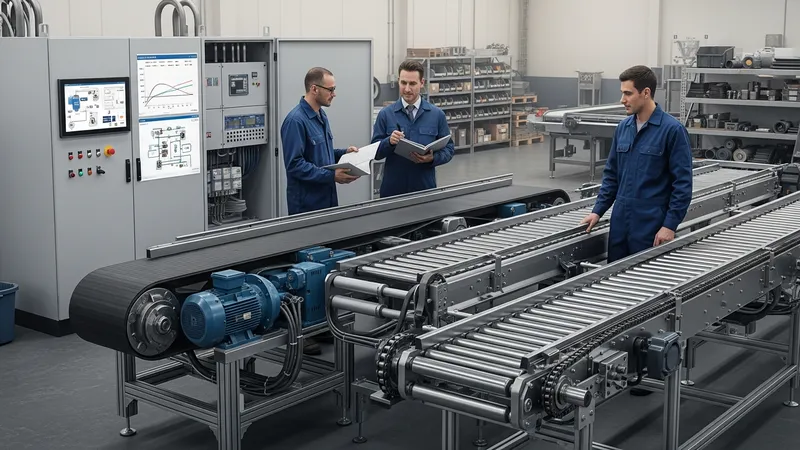
- Belt conveyors — Continuous conveyors using a looped belt for bulk or unit loads; commonly used for inclined, horizontal, or accumulation tasks with a range of belt materials for different products.
- Roller conveyors — Conveyors using cylindrical rollers for unit loads, parcel handling, or modular transfer; can be gravity-driven or motorised and often used in sortation or packing lines.
- Modular plastic chain conveyors — Conveyors built from interlocking plastic modules or chains that may offer hygienic cleaning advantages and flexible layouts for complex routing.
When comparing suppliers on system design and engineering support, buyers may examine how manufacturers translate process requirements into mechanical and control specifications. Suppliers typically provide technical drawings, load calculations, and layout proposals that indicate clearances, drive power, and structural support. Engineering depth can influence how well a supplier adapts standard modules to site constraints and how they account for thermal expansion, vibration, or floor flatness. These are factual considerations that can affect procurement timelines and the degree of on-site modification required.
Load capacity and material compatibility are frequently assessed through metrics such as maximum conveyed mass per unit time, belt width, line speed, and peak point loads. Different materials—powders, granules, sheets, or packaged goods—may require distinct belt materials, cleats, or containment features. Environmental factors like temperature, humidity, dust, and chemical exposure often inform material choices and protective coatings. Suppliers can usually provide typical capacity ranges and suggest component ratings, but final selection should be tied to measured or estimated process parameters.
Customization and automation features influence both functionality and lifecycle outcomes. Some suppliers provide modular platforms with configurable frame lengths, while others offer bespoke engineered solutions for unusual footprints or interfaces. Automation options commonly include variable-frequency drives, PLC-based sequence control, proximity sensing for accumulation, and integration points for higher-level supervisory systems. Software compatibility, data output formats, and maintenance access are technical aspects that may be specified to ensure long-term operability and integration with existing controls.
Maintenance support, spare parts logistics, and installation services are practical supplier capabilities often examined in parallel with equipment specifications. Suppliers may provide installation teams or supervised installation plans, preventive maintenance schedules, and spare-part kits sized to expected wear items. Lead times for critical components and availability of technical documentation such as wiring diagrams and parts lists can affect downtime risks. Considering these factual service elements helps purchasers form a more complete view of operating costs and reliability without implying guaranteed performance.
In summary, evaluating conveyor equipment suppliers requires a structured look at mechanical design, load and material handling characteristics, options for customization and automation, and the supplier’s installation and after-sales support. These elements collectively influence lifecycle cost, operational fit, and future adaptability. The next sections examine practical components and considerations in more detail.