
Conveyor Systems Manufacturers: Key Considerations When Selecting Industrial Suppliers

System types and design considerations for conveyor suppliers
Different conveyor types address distinct handling needs, and suppliers often present comparative data to match system types to application profiles. Belt conveyors may be specified for continuous, uniform transport and can vary by belt material for abrasion or food-contact compatibility. Roller conveyors typically suit discrete unit loads and may incorporate powered rollers or gravity sections. Modular plastic chain conveyors are commonly used where sanitary cleaning and complex routing are priorities. Suppliers may provide reference layouts, standard module dimensions, and nominal performance curves that illustrate how each system type behaves under typical operating conditions.
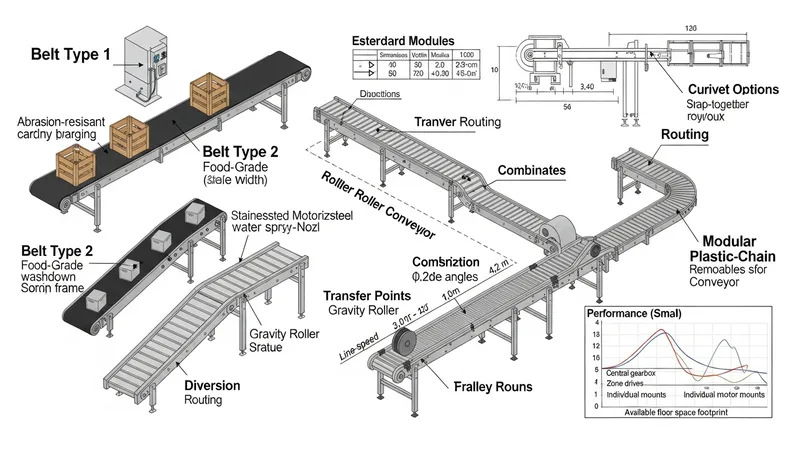
Design considerations frequently include belt or chain width, line speed range, incline capability, required transfer points, and available floor space. Suppliers typically offer standard widths and speeds with options to customize for atypical shapes or clearances. Drive selection—central drive, zone drives, or individual motor drives—can affect maintenance access and control complexity. Structural design addressing load distribution, support spacing, and mounting methods is often documented in drawings; purchasers may request finite-element or deflection data for critical spans where product orientation is sensitive to vibration or sag.
Material selection for belts, rollers, and structural elements often depends on contact requirements and environmental exposure. For example, food industry installations may require FDA-compliant belt materials and stainless-steel frames, while abrasive bulk handling may favour reinforced belts and hardened rollers. Suppliers generally indicate typical material options and their trade-offs in terms of wear resistance, cleanability, and cost. Design for maintainability—such as access panels, quick-change modules, and standardized fasteners—may be included as part of product families to reduce servicing time.
An important consideration is how easily a chosen system type integrates with upstream and downstream equipment. Transfer chutes, feed hoppers, sortation interfaces, and pallet handling stations can introduce alignment and timing constraints. Suppliers may provide control interface specifications and mechanical tolerance envelopes to aid integration planning. Including these interface details early in the design stage can clarify whether a modular solution or a custom-engineered conveyor is more appropriate, expressed as a practical trade-off rather than a prescriptive recommendation.