
Fall Alert For Seniors: How Personal Alert Systems Work At Home And Outdoors

Connectivity and Location Features in Senior Fall Alerts
Communication paths include local radio to a base station, Bluetooth to a paired smartphone, and built-in cellular modems that connect directly to a mobile network. Base stations are useful for in-home coverage but do not extend outdoors; Bluetooth solutions are limited by typical Bluetooth range and require the phone to be present and connected. Cellular-enabled wearables provide broader geographic coverage when a mobile network is available, but signal strength varies with location and carrier. Understanding the primary environments where the person spends time helps determine which connectivity model may be most appropriate.
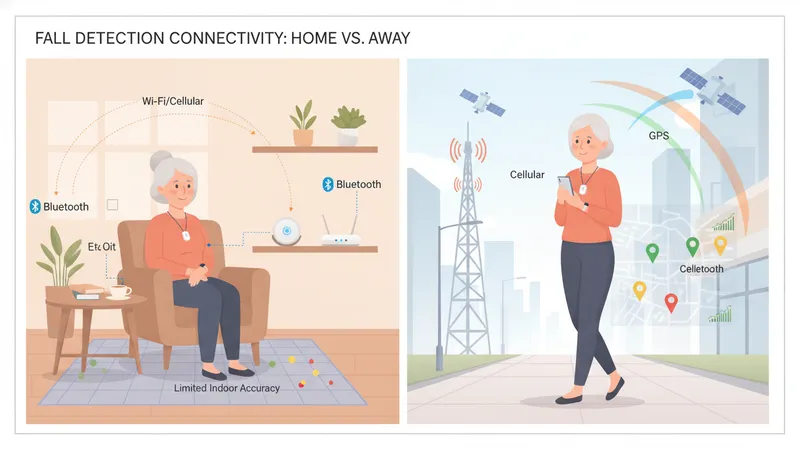
Location reporting varies by method and environment. GPS generally supplies better outdoor location accuracy but can be unreliable inside buildings or in dense urban areas with obstructed sky view. Assisted GPS and cell-tower triangulation can improve location estimates when pure GPS signals are weak, though accuracy may be degraded. Bluetooth beacons or Wi‑Fi-based indoor location systems can support finer indoor positioning in some settings, but these require additional infrastructure. For outdoor activities such as walking or errands, devices that include GPS or that can transmit a phone’s location often provide more actionable location information.
Latency and message reliability are practical concerns. Cellular messages and data can be delayed during network congestion or in areas with limited coverage. Systems that provide two-way voice through the wearable or base station allow for immediate verbal assessment, which can reduce the need for rapid location precision in some cases. For critical incidents, redundancy—such as a wearable with cellular plus the option to notify personal contacts who can use phone-based location sharing—may increase the chances that appropriate help arrives.
Privacy and data handling are connected to connectivity choices. Devices that regularly transmit continuous location or high-frequency motion data create a data footprint that may be stored by service providers. Users and caregivers benefit from reviewing privacy policies and data retention practices to understand who may access location and event logs, how long information is retained, and what consent options exist. These considerations are often balanced against the practical benefits of improved location reporting when an incident occurs.