
Fiber Internet: Understanding Service Options And Connection Types

Types of fiber connections and practical differences
Definitions for common connection types inform expectations about performance and installation. FTTH/FTTP places fiber directly to an individual unit, which often reduces signal conversion points and supports symmetric bandwidth. FTTB brings fiber to a building’s distribution point; the in-building medium—copper phone lines, coax, or Ethernet—then determines final delivery characteristics. FTTC and FTTN terminate fiber at a street cabinet or node and rely on existing metallic wiring for the remaining distance; this last-mile medium often imposes greater variability in achievable rates, especially over longer runs. Understanding these practical differences helps set realistic service expectations without assuming specific speeds.
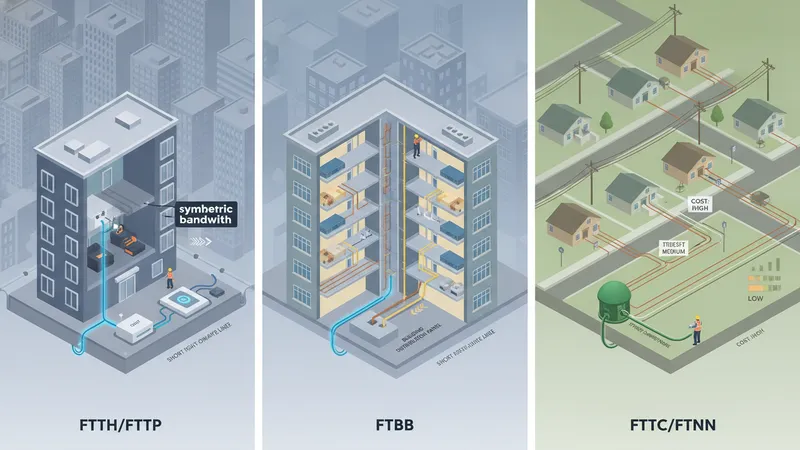
Deployment choices are frequently influenced by density and cost considerations. In dense urban or new-build scenarios, extending fiber to individual premises may be more feasible because of shorter distances and consolidated rights-of-way. In suburban or rural areas, reaching every premises with individual fiber may require higher capital investment per subscriber, so providers may initially choose cabinet or node-based solutions that reuse existing wiring. These deployment patterns often shape availability timelines and the technical characteristics of plans offered in different neighborhoods.
From a maintenance perspective, fiber-to-premises runs reduce the number of transitional interfaces and therefore the number of potential failure points inside the access network, although outside plant issues such as fiber cuts or joint failures can still occur. Cabinet- or node-based models concentrate service conversion equipment in street-level enclosures that may require distinct cooling, power, or access arrangements. Operators typically balance those operational considerations with expected subscriber counts when selecting a deployment approach for a specific area.
For end users and building managers, the visible implications include where the ONT or distribution equipment is located, whether internal wiring upgrades may be required, and whether any building-wide coordination is needed for installations. Property-level constraints—such as shared comms closets, conduit access, or historical wiring—can influence how quickly a particular connection type can be completed. These logistical factors are part of the practical differences among connection types and are worth documenting when comparing options.