
Fiber Internet: Understanding Service Options And Connection Types

Network architectures and equipment considerations for fiber
Two common architectures in optical access are passive optical networks (PON) and active Ethernet. PON uses passive splitters to divide a single fiber’s optical signal among several endpoints, reducing fiber counts and often lowering deployment capital for providers. Active Ethernet assigns a dedicated fiber per subscriber and requires powered switching equipment in the operator’s exchange. Equipment at the premises commonly includes an ONT to terminate the optical signal and a router to handle local-area networking; responsibilities for ownerhip and support of that equipment depend on the service agreement.
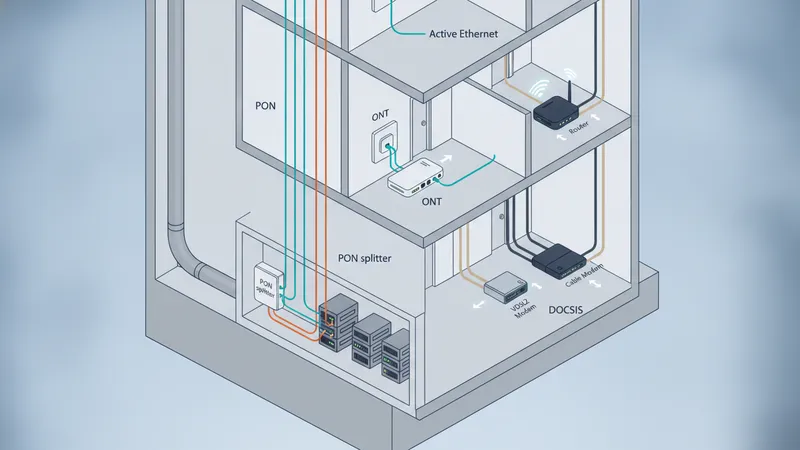
ONT placement and interface standards affect user experience and compatibility. The ONT typically provides Ethernet ports and possibly voice or coax outputs; it converts optical signals to electrical signals usable by a consumer router or existing wiring. In multi-dwelling configurations, a single building-level optical termination may feed a distribution switch or structured cabling system. When existing in-building copper is used, technologies such as VDSL2 or DOCSIS over coax may be used for the final leg, and the expected throughput will depend on the quality and length of that wiring.
Provider-side equipment also matters for scaling and service flexibility. OLTs (optical line terminals) in PON networks manage downstream and upstream scheduling and may support multiple split ratios; slotting and module choices influence how many users are served per port. Active Ethernet deployments require more fiber strands but can simplify provisioning of dedicated bandwidth per subscriber. Both architectures may support multi-gigabit upgrades through equipment changes at central offices and without replacing last-mile fiber in FTTH scenarios.
For consumers assessing equipment arrangements, considerations include whether the provider supplies and maintains the ONT and whether a separate router is permitted or required. Compatibility with existing home networks, voice services, and in-unit wiring is another factor. Where dedicated fiber reaches the premises, users may see simpler upgrade paths to higher bandwidth tiers because the optical medium itself can support higher wavelengths and modulation schemes with appropriate terminal equipment changes.