
Food Industry Metal Detectors: Principles Of Operation And Key Components

Detection principles and electromagnetic fields in food industry metal detectors
Detection begins with electromagnetic field generation and the relative disturbance produced by a metal object. Transmitter coils produce an alternating field; receiver coils detect perturbations when conductive or ferromagnetic materials pass through the aperture. Balanced coil geometries aim to cancel the nominal field so that only perturbations above a threshold produce a measurable signal. Digital filters and signal processing may be applied to distinguish genuine metal signatures from noise caused by product movement or nearby equipment. Multi-frequency methods can improve discrimination by comparing responses across different frequencies.
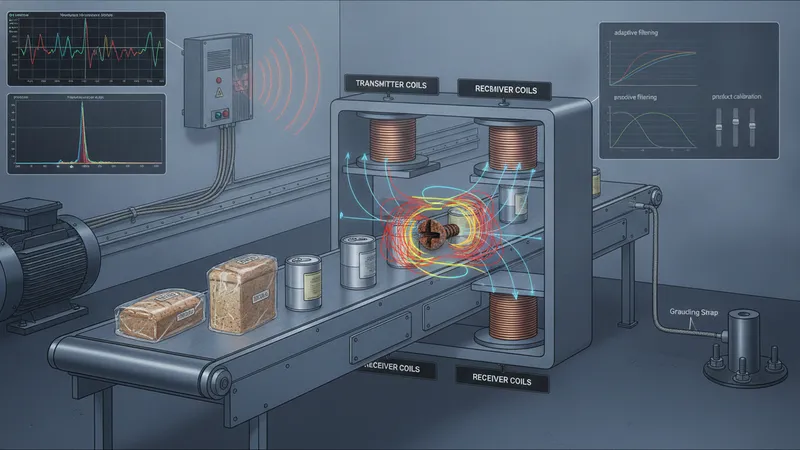
Signal stability is affected by environmental factors and product properties. Motors, variable-frequency drives and nearby electrical equipment may introduce electromagnetic interference that can be mitigated through system grounding, cable routing, and shielding. Product effect—where the product’s conductivity or dielectric properties alter the base signal—can cause drift or false rejects; compensatory techniques such as product calibration, adaptive filtering, or gated timing may be used. When evaluating performance, users often consider both raw sensitivity and the operational false-reject rate under production conditions.
Different detector placements create distinct field geometries and operational considerations. Conveyor-aperture detectors typically present a rectangular or tunnel-shaped field aligned with the belt, which suits packaged items and discrete products. Pipeline detectors surround the product flow and require sanitary wetted designs for liquids and viscous products; field uniformity and pipe wall thickness are factors that can affect sensitivity. Free-fall or chute-mounted detectors must account for product orientation and tumbling, which can reduce effective detection for small or irregularly shaped contaminants.
Practical design choices arise from balancing detection goals and production constraints. Increasing aperture size may accommodate larger products but can reduce sensitivity to small particles at the aperture center. Higher conveyor speeds can shorten the time a contaminant remains in the aperture, which may affect signal-to-noise ratios and necessitate faster processing electronics. Electrical and mechanical integration choices are often made considering cleaning regimes, downtime impacts, and the operational environment to ensure the detector functions reliably within the processing line.