
High Viscosity Pumps: Key Design Features And Operating Principles

Pumps intended for very thick or slow-flowing liquids are designed to move fluids whose resistance to flow is substantially greater than water. Such designs focus on creating predictable displacement per cycle, controlling clearances to manage leakage, and avoiding excessive shear or trapped gas. Typical engineering responses include selecting positive-displacement mechanisms, specifying low rotational speeds, adding temperature control to reduce apparent viscosity, and detailing seal and bearing arrangements that tolerate heavier lubricating fluids or abrasive solids. The overall concept centers on matching pump geometry and drive conditions to the fluid’s rheology so that flow and pressure remain stable under expected process temperatures.
Key operational factors involve how viscosity interacts with pressure and flow. As viscosity increases, required input torque and volumetric slip often increase, so designers may enlarge gear sizes, lengthen rotor profiles, or select multi-lobe geometries to preserve steady throughput. Some viscous fluids are shear-sensitive or non-Newtonian; these characteristics influence whether a rotary, piston, or progressive-cavity approach is preferable. Auxiliary systems such as heating jackets, slow-speed gearboxes, and pressure relief devices are commonly integrated to keep performance within safe, maintainable ranges without implying a single universal solution.
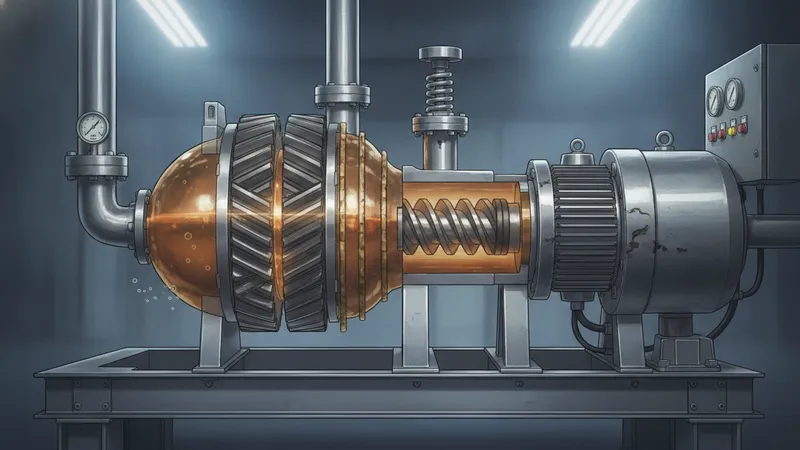
- External gear pump — rotary positive-displacement pump with closely meshed gears; often used for moderately viscous liquids where steady flow at moderate pressure is needed.
- Progressive cavity (single-screw/Moineau) pump — helical rotor in an elastomeric stator that creates progressing cavities; typically chosen for very viscous, shear-sensitive, or particulate-laden fluids.
- Rotary lobe pump — non-contact lobes that produce large, low-shear chambers; can handle viscous fluids and solids at lower rotational speeds with manageable pulsation.
Viscosity influences volumetric efficiency and required drive power in measurable ways. For a given pump geometry, volumetric slip (internal leakage past clearances) can increase with higher viscosity, reducing delivered flow relative to theoretical displacement; however, in some positive-displacement designs slip may decrease because thicker fluid seals gaps more effectively. Drive power typically scales with both flow rate and viscosity, so torque requirements may be several times larger than for low-viscosity liquids at similar flow rates. Designers often specify safety margins for torque and bearing loads to account for steady-state and start-up conditions.
Clearances, tolerances, and surface finishes are central to reliable handling of thick fluids. Smaller clearances can reduce internal leakage but may increase the risk of seizure if thermal expansion or entrained solids are present. Surface roughness affects shear and abrasion; polished wetted surfaces can reduce adhesion and assist self-priming in some rotary types. Elastomer stators or seals are chosen based on chemical compatibility and hardness; softer elastomers may improve sealing in progressive-cavity pumps but can wear faster with abrasive particles. These trade-offs are addressed in material selection and planned maintenance intervals.
Temperature control is a common method for managing viscosity in-service. Heating jackets, fluid-filled heat-transfer circuits, and trace heating on suction lines can lower apparent viscosity sufficiently to reduce torque and improve volumetric output. For shear-thinning fluids, pumping at slightly higher shear rates can reduce apparent viscosity locally, but excessive shear may damage product properties. Where heating is used, expansion, seal compatibility at elevated temperatures, and uniformity of temperature across the pump and piping must be considered to avoid uneven flow or degraded components.
Maintenance planning and monitoring are important for long-term performance. Wear of rotors, stators, and seals can gradually change clearances and thus flow and efficiency; scheduled inspections can identify progressive changes before abrupt failure. Vibration analysis, torque monitoring, and routine checks for seal leakage are commonly used diagnostics. Spare-part strategies typically include replacement rotors or stators and seal kits sized for expected service intervals. The next sections examine practical components and considerations in more detail.