
High Viscosity Pumps: Key Design Features And Operating Principles

Pump types and mechanical principles for viscous liquids
Rotary and reciprocating positive-displacement mechanisms are widely used when liquids have high apparent viscosity because they deliver a defined volume per cycle. External gear pumps generate flow by entraining liquid between gear teeth and the casing; they can be compact but may require more precise clearances. Progressive cavity pumps create a moving cavity that advances fluid with minimal backflow; this is often useful for shear-sensitive or particulate-containing fluids. Rotary lobe pumps provide large cavities and gentle handling, and may be chosen where low shear and ease of cleaning are priorities. Selection often depends on a balance of volumetric accuracy, allowable shear, and solids handling.
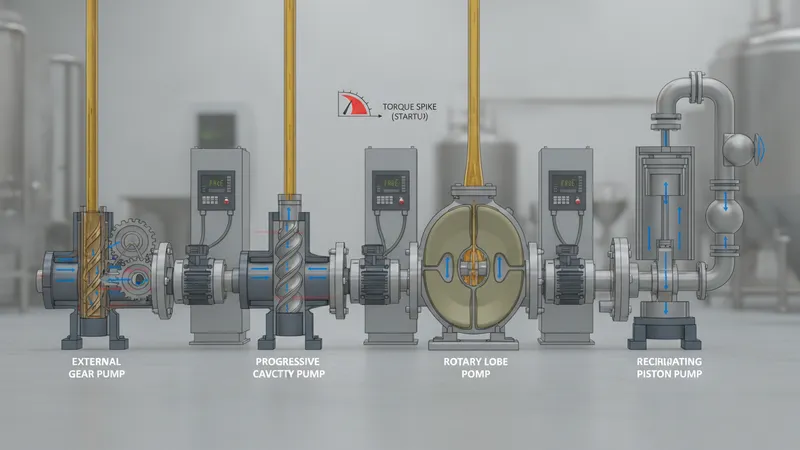
Operational speed and drive selection are practical considerations tied to the selected pump type. Lower rotational speeds typically reduce shear and heat generation but may require larger displacement per revolution to meet flow targets. Gearboxes or variable-frequency drives may be used to tune speed within process constraints. Reciprocal piston pumps can achieve high pressures but produce pulsation that often needs dampening. The combination of pump geometry, drive power rating, and coupling design is specified to maintain acceptable torque margins during start-up, when viscous suction conditions can increase transient loads.
Seal and shaft-bearing arrangements differ by pump family and influence maintenance needs. Seal types range from packing and single mechanical seals to cartridge double seals for pressure-critical applications. For very viscous fluids, seals may need to be warmed or provided with barrier fluids to prevent congealing. Bearings must accommodate higher radial loads from viscous torques and potential imbalance; some designs use larger, heavier bearings or external oil lubrication systems. These mechanical details are integral to overall pump reliability and are considered alongside material compatibility.
Flow control and pulsation management are often incorporated at the system level. Positive-displacement pumps can generate pulsation that affects downstream metering or mixing; surge dampeners, pulsation dampers, or downstream accumulators may be applied. In applications where metering accuracy is important, pump selection and speed control are coordinated with feedback instrumentation. Engineers commonly model expected slip and pulsation behavior during the specification phase to size control elements that preserve process stability without implying a single universal configuration.