
Laser Eye Surgery: Understanding Procedures, Techniques, And Common Outcomes

Types of laser refractive procedures and how they differ
LASIK, PRK, and SMILE each represent a different technical approach to modifying corneal shape. LASIK commonly involves creating a flap and ablating stromal tissue beneath it, which can allow relatively rapid visual recovery for many patients. PRK removes the epithelial layer and applies ablation to the surface, which can reduce flap-related complications but may have a longer initial healing phase. SMILE uses a femtosecond laser to create and remove a lenticule through a small incision, with the intent of preserving anterior corneal biomechanics more than some other methods. These structural differences may influence choosing one technique over another.
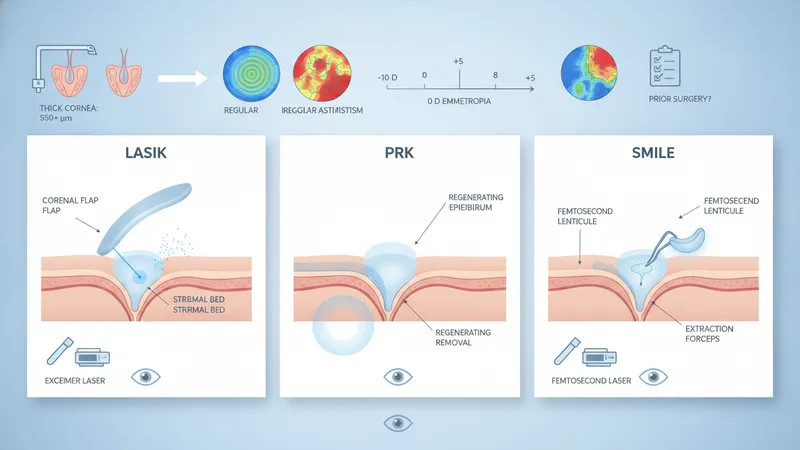
Clinical selection often balances corneal thickness, topographic regularity, and the magnitude of refractive error. For example, thin corneas or irregular topography may steer clinicians toward surface ablation or alternative treatments, whereas stable, moderate myopia with sufficient thickness might be treated with flap-based approaches or lenticule extraction. The presence of significant higher-order aberrations or prior ocular surgery can also guide the choice of procedure and the use of customized ablation protocols that aim to address optical irregularities beyond simple sphere and cylinder correction.
Healing responses vary among techniques, and recovery trajectories may differ accordingly. Surface procedures such as PRK typically require epithelial regeneration and may produce greater short-term discomfort and slower visual stabilization, often over days to weeks. Flap-based LASIK often yields faster visual stabilization in the early postoperative period for many patients, though both approaches can show ongoing refractive shifts for several months. SMILE recovery profiles may fall between these approaches for some patients, with reports indicating variable timelines depending on individual healing.
When comparing techniques, it is useful to view outcomes as probabilistic rather than guaranteed. Studies and clinical reports often summarize typical ranges of reduction in refractive error and rates of patient satisfaction, but individual results depend on preoperative measurements, surgical precision, and healing. Patients and clinicians commonly consider trade-offs among recovery speed, surface disruption, and the potential need for later enhancement procedures when selecting an approach. Further sections address technologies and planning that inform these choices.