
Remote Patient Monitoring Devices: Understanding Connected Health Technologies And Their Uses

Data transmission, standards, and integration considerations
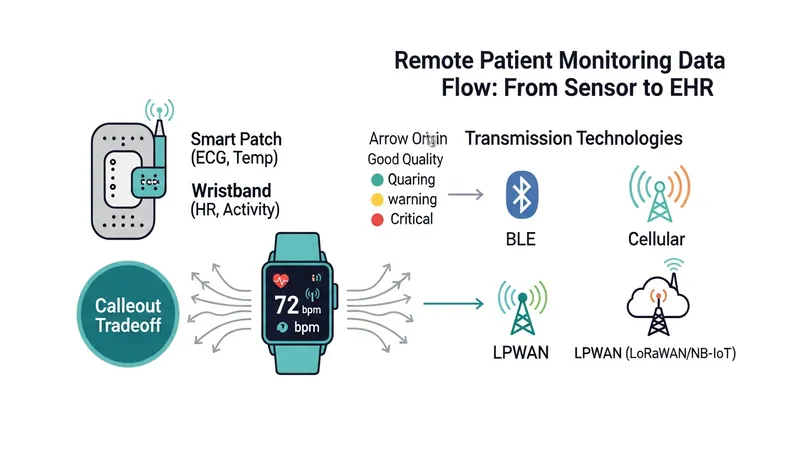
Connectivity options for remote monitoring range from short-range protocols (Bluetooth Low Energy) to long-range options (cellular or low-power wide-area networks). Gateway devices such as smartphones or dedicated hubs often perform initial aggregation and encryption before forwarding data to cloud platforms. Design choices affect data timeliness, with direct cellular often reducing reliance on intermediary devices but potentially increasing device cost. Data buffering strategies and local storage can mitigate temporary connectivity loss, while secure pairing and authentication mechanisms reduce the risk of unauthorized device access during routine communication.
Interoperability standards play a role in integrating monitoring data into clinical systems. Health Level Seven (HL7) and Fast Healthcare Interoperability Resources (FHIR) commonly guide how discrete observations and device metadata are represented. Implementation may require middleware or translation layers to map device-specific payloads into standardized resources for electronic health records. Metadata such as measurement context, device ID, calibration timestamps, and data quality markers may be important to preserve during integration so that clinicians can interpret readings appropriately within the patient record.
Latency, bandwidth, and privacy considerations influence how raw data and derived analytics are managed. Continuous waveforms or high-frequency accelerometer data can be bandwidth-intensive and are often processed locally or summarized before transmission to conserve resources. De-identified or aggregated analytics may support population-level monitoring without exposing identifiable data, while patient-level records require stronger access controls and audit logging. Encryption in transit and at rest, credential management, and adherence to applicable privacy frameworks are typical elements of a data governance approach for connected monitoring programs.
Operational factors in integration include mapping alert thresholds, creating clinician-facing dashboards, and defining escalation pathways. Alert fatigue can occur if thresholds are not tuned or if systems generate high volumes of nonactionable notifications; program teams often test and refine alert logic before broad deployment. Integration efforts may also involve training clinicians on where monitoring data appears in workflows, how to document responses, and how to reconcile device-derived measurements with in-person assessments. These integration steps can determine whether monitoring data is used as a supplemental information stream or becomes an integral part of routine care.