
Rubber Mixer Machine: Overview Of Types, Components, And Applications

Mixing processes, parameters, and temperature control in rubber compounding
Mixing workflows often follow a defined sequence: pre-blending of powders, staged addition of fillers, incorporation of plasticizers and process aids, and final addition of curatives near discharge to limit premature reaction. Sequence and timing can influence dispersion and vulcanization behavior; for temperature-sensitive curatives, delayed addition or lower-temperature blending steps may be typical. Process engineers frequently document parametric windows—such as rotor speed ranges, fill ratios, and target chamber temperatures—to support repeatability across batches or shifts.
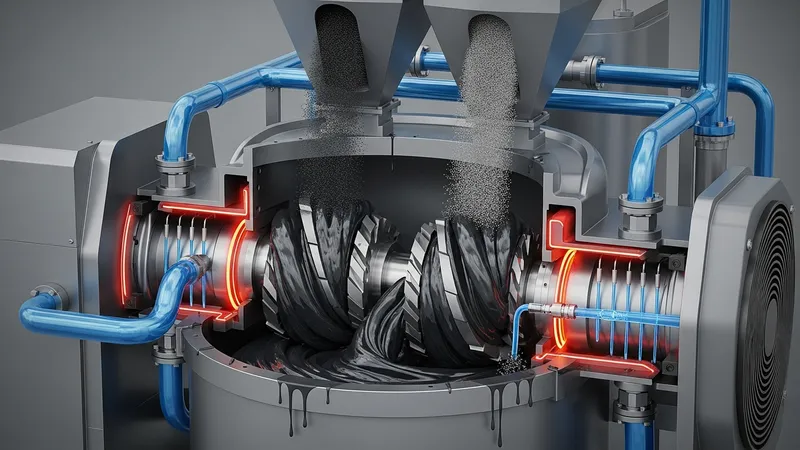
Energy input to the compound, sometimes described through specific energy or power/torque profiles, can indicate dispersion progression. Monitoring trends in motor current or torque may help identify when filler networks have broken down sufficiently, though these signals are process-relative rather than absolute. Temperature rise during mixing results from mechanical energy dissipation and exothermic reactions; managing heat removal through cooling passages or intermittent mixing sequences can limit undesired chemical activation and maintain workable viscosities.
Instrumentation and control strategies commonly include closed-loop temperature control, recipe-based sequencing, and data logging for cycle parameters. Laboratory tests such as dispersion index, particle size distribution of fillers, and rheometry (e.g., Mooney viscosity, cure curves) are used to correlate process settings with final compound behavior. These analytical techniques often guide adjustments in mixing time or rotor speed rather than serving as stand-alone directives, supporting iterative process optimization in a measured way.
Operational tips presented as considerations include staging high-energy dispersion steps early and introducing curatives near the end of mixing to reduce scorch risk, and considering lower fill factors when dispersing highly loaded formulations to improve movement and heat dissipation. Balancing shear and temperature often involves compromise: increasing shear improves filler wetting but may increase temperature; cooling capacity and real-time monitoring can help manage this trade-off during process development and routine operation.