
Solar Electricity: Essential Concepts And How Solar Power Is Generated

Solar electricity: Photovoltaic cell function and panel construction
Photovoltaic cells rely on semiconductor junctions to separate photo‑generated charge carriers; when light is absorbed, electrons and holes are created and driven apart by an internal electric field, producing a voltage. Cells are typically assembled into modules with protective glass, encapsulant, and a backsheet to guard against moisture and mechanical stress. Electrical connections among cells establish series and parallel arrangements to reach desired voltage and current levels. Thermal behavior also matters: cell temperature typically affects voltage and thus module output, so module materials and ventilation influence operational performance.
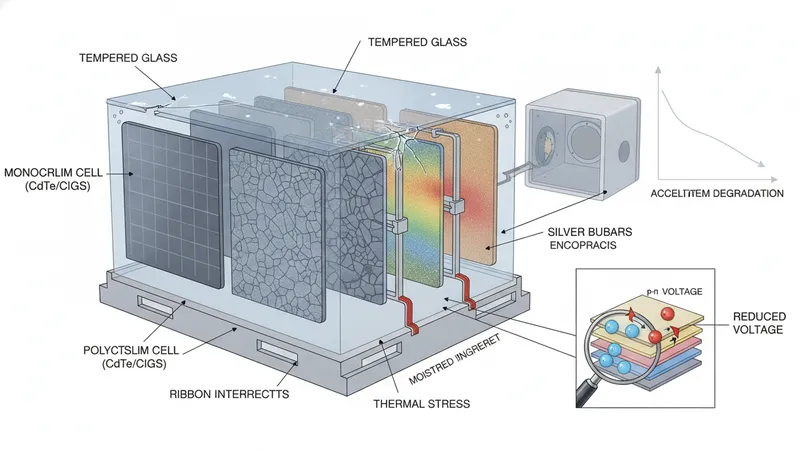
Different semiconductor materials and manufacturing methods yield distinct electrical and mechanical properties. Crystalline silicon remains widely used, with monocrystalline and polycrystalline variants differing in wafer structure and potential efficiency per area. Thin‑film technologies, such as cadmium telluride or copper indium gallium selenide, can offer advantages in specific environmental or mounting scenarios. Module degradation pathways may include ultraviolet exposure, moisture ingress, and thermal cycling; manufacturers typically perform accelerated testing, while system designers often account for long‑term performance declines when estimating energy production.
Module mounting and layout choices affect incident irradiance and maintenance. Fixed‑tilt arrays are common for simplicity, while single‑axis or dual‑axis trackers can increase energy capture by following the sun’s path, often at added mechanical and maintenance complexity. Shading from nearby trees, buildings, or soiling can create mismatch between cells and strings, reducing output; bypass diodes and module‑level power electronics are typical mitigations. Designers also consider wind and snow loads, corrosion resistance, and access for cleaning to support reliable generation over the system life.
Standardized test ratings (for example, power under standardized irradiance and temperature) provide a baseline for comparing modules, but actual yield often differs due to local climate, spectral conditions, and installation tilt or azimuth. Performance models typically use irradiance data and temperature coefficients to estimate expected generation over time. When planning installations, analysts may use historical solar resource data and simulation tools to project energy production while acknowledging that operational results can vary from modeled outputs.