
Solar Electricity: Essential Concepts And How Solar Power Is Generated

Solar electricity: Inverters and power‑conditioning considerations
Inverters convert DC electricity produced by photovoltaic modules into AC compatible with loads and electrical networks. They perform voltage and frequency shaping, MPPT, and protective functions such as anti‑islanding. Architectures vary: central inverters handle large arrays, string inverters manage groups of panels, and microinverters convert at the module level. Each approach may influence monitoring resolution, fault isolation, and the degree to which individual module performance affects overall system output. Power conditioning also includes filtering and surge protection to meet system and safety requirements.
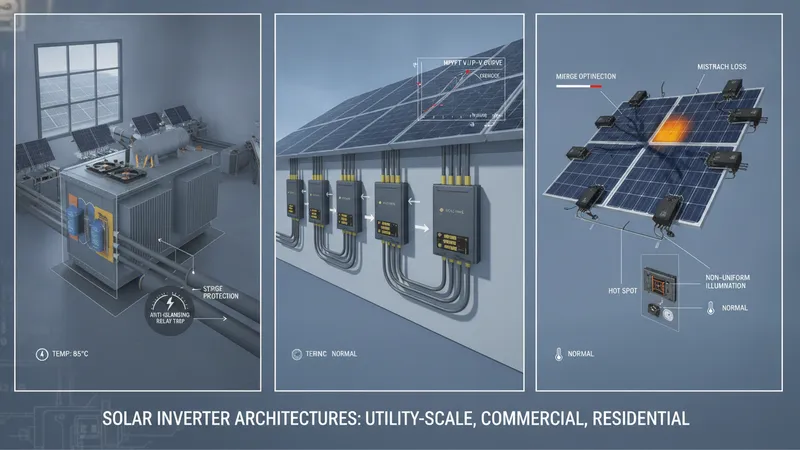
Maximum power point tracking algorithms are central to extracting usable energy under changing irradiance and temperature. MPPT strategies search for the voltage/current condition that yields the highest product of current and voltage for given environmental conditions. When modules experience non‑uniform illumination, module‑level MPPT (via microinverters or optimizers) can reduce loss from mismatch. Inverter thermal management and ambient temperature can affect efficiency; derating may occur at elevated temperatures, making ventilation and component selection important for consistent performance.
Grid‑interactive inverter features may include reactive power control, voltage regulation, and ramp‑rate limitations, which can support grid stability in some jurisdictions. Compliance with interconnection standards commonly dictates functions like anti‑islanding and may require specific response behaviors during frequency or voltage excursions. For off‑grid or hybrid systems, inverters often incorporate battery‑charging controls and waveform shaping suitable for local loads; these combined inverter‑charger units can coordinate charging priorities and load support without a grid connection.
Monitoring and diagnostics provided by inverters can inform maintenance and performance assessment. Data on energy production, voltage, current, and fault codes often allow operators to detect underperformance or component issues. Remote monitoring platforms may present module‑level or system‑level metrics depending on the power‑electronics architecture. While monitoring can aid troubleshooting, designers often weigh the tradeoffs among monitoring resolution, data handling complexity, and cost when selecting equipment for a given installation.