
Solar Electricity: Essential Concepts And How Solar Power Is Generated

Solar electricity: Energy storage, controllers, and integration with supply
Energy storage systems paired with solar generation decouple production from consumption timing by storing excess generation and releasing it when needed. Storage is sized based on load profiles, desired autonomy, and depth‑of‑discharge considerations. Battery chemistry affects cycle life, energy density, safety characteristics, and operating temperature ranges. Charge controllers and battery management systems regulate charging currents and cell balancing to reduce degradation. Storage may be integrated for backup, load shifting, or smoothing of variable solar output, each application shaping sizing and control strategies.
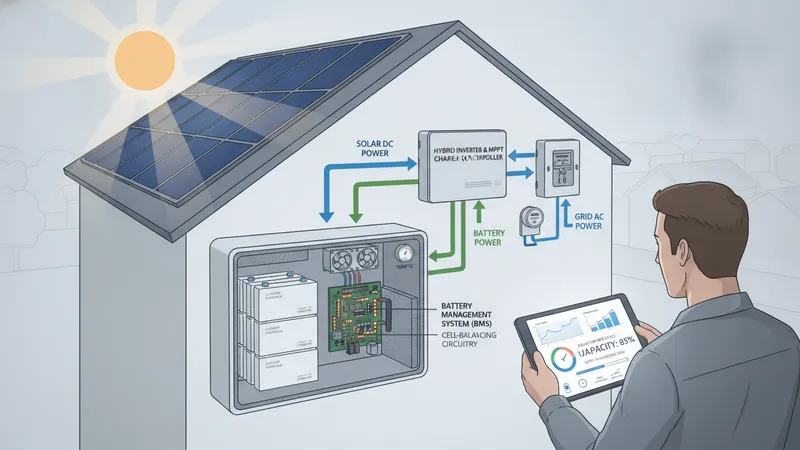
When integrating storage, round‑trip efficiency and usable capacity are typical planning metrics. Round‑trip efficiency describes energy retained after a full charge/discharge cycle and depends on converter losses and battery chemistry. Usable capacity accounts for recommended depth‑of‑discharge limits to preserve battery life. Thermal management and appropriate enclosures often matter, as temperature swings can accelerate aging. Designers commonly model storage dispatch strategies to align with household or facility demand patterns and to account for anticipated variability in solar generation.
Interfacing storage with the grid introduces additional considerations, such as islanding detection, synchronization, and complying with interconnection rules for energy export. In hybrid systems, controllers prioritize charging/discharging sequences: for instance, directing solar generation to loads first, then to storage, and finally to export, depending on configuration. Backup configurations may require transfer switches and coordination to ensure safety and continuity when the grid is unavailable. Systems intended for resilience often include redundancy and state‑of‑charge management to maintain critical loads during extended outages.
Economic and lifecycle considerations often shape storage selection and operational strategies. Batteries may have specified cycle lifetimes, calendar degradation rates, and warranty terms that inform total cost of ownership analyses. Maintenance needs, recycling pathways, and end‑of‑life handling are also relevant. Because technology and cost trajectories can change, planners typically model multiple scenarios to understand how storage performance and degradation can affect long‑term system behavior rather than assuming fixed outcomes.