
Straddle Stackers: Key Features, Functions, And Typical Applications

Straddle stackers are warehouse material-handling machines designed to lift and move palletized loads while straddling the pallet or load base. They typically consist of a frame with legs that pass on either side of a pallet, forks or a platform to support loads, and a mast with a lifting mechanism. Models range from manually operated hand-pump units to electrically powered machines with hydraulic or electric mast drives. These machines may be used where access is limited, where racking requires low clearances, or where load stability during lifting is a primary concern.
Their core functionality includes lifting loads to intermediate heights for stacking, transporting loads across short distances inside facilities, and positioning pallets for storage or retrieval. Control interfaces vary: manual units use physical levers and push/pull effort, while powered units often provide electronic controls, variable speed travel, and lift/lower actuation. Typical performance characteristics to consider are rated load capacity, lifting height, footprint width, and turning radius. Operation is usually confined to level, indoor surfaces and may require operator familiarity with pallet sizes and floor conditions.
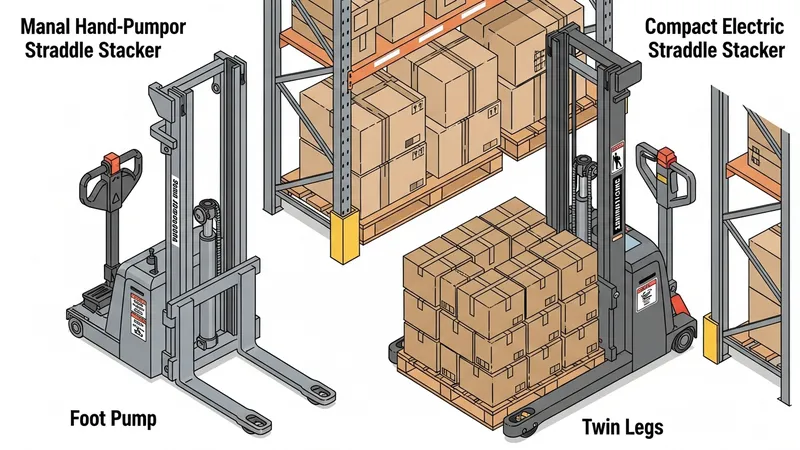
- Manual straddle stacker — A hand-operated unit with a hydraulic pump and crank or lever control; often used for light loads and short lifts where power is not required.
- Electric powered straddle stacker — A battery-driven model with electric lift and drive motors; typically offers reduced operator effort and higher lift heights compared with manual units.
- High-lift or turret-capable straddle stacker — Designed for increased lift heights or narrower aisle operation; may include features for rotating loads or improved mast stability.
Design and chassis features often determine how a straddle stacker fits into facility workflows. Leg span and fork length dictate the pallet types that can be accommodated, while overall width affects aisle compatibility. Some units have adjustable legs or removable extensions to handle non-standard pallets. The mast design—single, duplex, or triplex—affects the maximum lift height and the collapsed height for maneuvering under obstacles. Frame materials and joint design may influence durability and service intervals; heavier-duty construction can increase service life in intensive use settings.
Lifting mechanisms vary and typically influence speed, capacity, and maintenance needs. Manual units usually rely on a hydraulic pump actuated by hand, which limits lift speed and operator endurance. Electric units can use hydraulic or chain-and-roller systems driven by electric motors; these can offer smoother, faster lifting and integrated brake systems. Rated capacities commonly range from a few hundred kilograms to over a ton, depending on the design. Load center, attachment geometry, and stability calculations often determine the actual safe working load under given conditions.
Maneuverability and controls are practical considerations in selection and operation. Steering systems may be centered on a tiller arm for pedestrian operation or include seated operator stations for larger powered units. Drive configurations influence turning radius and handling on different floor types; electric drives may include regenerative braking or speed control features. Visibility to the forks and load is important for safe placement; some masts are designed with open profiles or transparent sections to improve sightlines. Floor conditions, including slope and surface irregularities, often limit operational areas.
Maintenance and inspection practices typically affect uptime and long-term operating cost. Regular checks often include hydraulic fluid levels, battery condition for electric units, fork and mast wear, wheel condition, and the function of brakes and safety interlocks. Preventive maintenance schedules may follow manufacturer guidance and facility usage patterns, with heavier use requiring more frequent calibration or replacement of wear items. Operator training on routine inspections can help identify issues early; such inspections may be brief but can reduce the likelihood of mechanical faults during operation.
In summary, straddle stackers combine a narrow operational footprint with the capacity to lift and position palletized goods where full-size forklifts may be impractical. Variations in drive system, mast configuration, and chassis dimensions typically influence suitability for particular tasks and environments. Selection often balances lifting height, load capacity, maneuverability, and maintenance expectations. The next sections examine practical components and considerations in more detail.