
Straddle Stackers: Key Features, Functions, And Typical Applications

Configuration and Types of Straddle Stackers
Different configurations of straddle stackers address varied operational needs. Common distinctions include manual versus powered drives, the number of mast stages (single, duplex, triplex), and leg or fork adjustability. Manual jack-style stackers may be suitable for intermittent, low-height use and often present lower capital complexity. Electric models can provide higher lift speeds and reduced operator effort, which may be relevant for repetitive tasks. Adjustable-leg designs can accommodate irregular pallets or caged loads. Understanding these configurations helps align a unit’s capabilities with facility constraints such as aisle width and pallet dimensions.
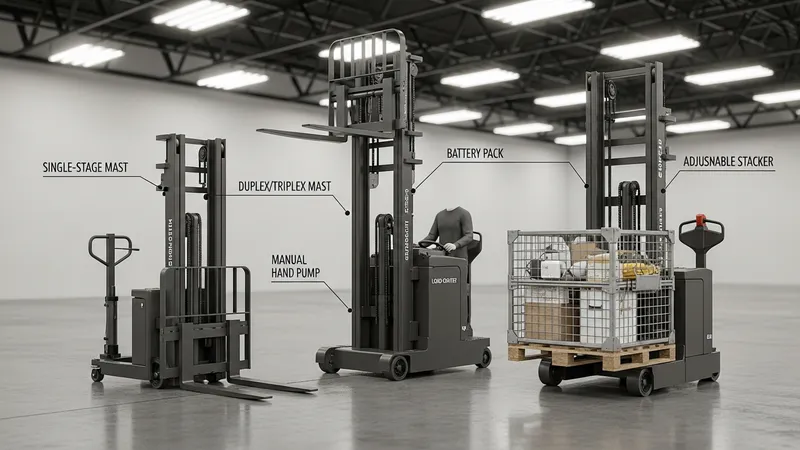
Chassis and fork geometry also affect compatibility with common pallet types and load profiles. Fork length and spacing must match pallet base dimensions to avoid instability. Some units offer removable or telescoping forks to handle non-standard pallets or crates. The straddle legs may be fixed or foldable; foldable legs can facilitate storage or transition through narrow doorways, while fixed legs tend to be mechanically simpler. Manufacturers may provide specification sheets that list recommended pallet sizes and load centers for each model, which can inform planning without prescriptive advice.
Drive and steering arrangements vary and can influence operator ergonomics and control precision. Tiller-steered pedestrian units often provide compact control for walking operators, while ride-on or platform variants may be used when longer travel distances are required. Electric drives commonly provide variable speed control and may include integrated safety features such as dead-man switches or controlled deceleration. When considering configuration, it may be useful to map typical travel routes, floor conditions, and lift sequences to potential machine footprints and steering systems to identify likely fit.
Operational trade-offs appear across configurations: manual units can be simpler to maintain but slower to operate, while powered units can improve throughput at the cost of battery maintenance or electrical systems servicing. Mast stage count can allow higher stacking but may increase complexity and reduce rigidity. Facilities often balance these variables by matching duty cycles—frequency and duration of lifts—to the stacking equipment’s rated design. These considerations may guide specification and procurement discussions in an informational way rather than acting as prescriptive recommendations.