
Straddle Stackers: Key Features, Functions, And Typical Applications

Lifting Mechanisms and Load Capacity Considerations
Lifting systems in straddle stackers commonly include hydraulic cylinders, chain-and-sprocket assemblies, or electric-actuated lifts. Hydraulic lifts may be manually pumped or energized by an electric motor. Chain-driven masts are frequently used for higher lifts where synchronized travel of mast stages is required. Rated load capacity is typically specified at a particular load center; shifts in the load center or adding attachments can reduce the effective capacity. Specifications often list a nominal capacity and the corresponding lift height at that rating, which can be used to compare potential suitability for tasks.
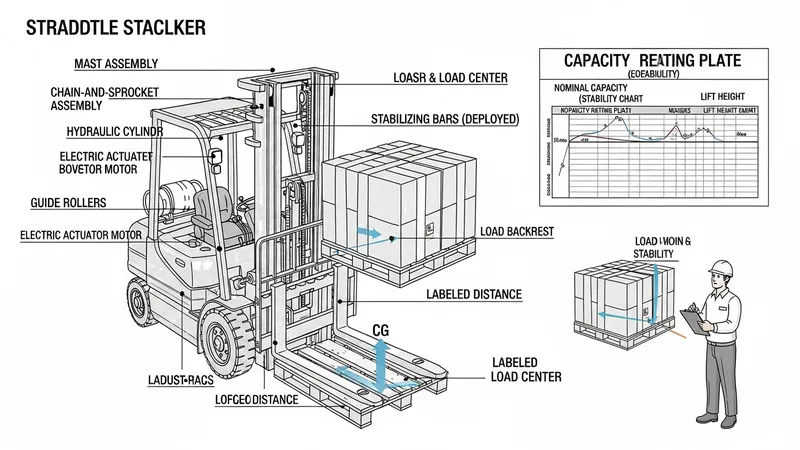
Load center and stability calculations often determine actual safe working loads under real conditions. The load center is the distance from the fork face to the center of gravity of the load and is a critical parameter in capacity tables. Moving bulky or top-heavy loads can reduce stability and should be accounted for in planning. Some straddle stackers include load backrests, wider fork spacing, or stabilizing bars to improve load support. These are design features that may influence handling characteristics rather than guarantees of performance.
Typical capacity ranges for warehouse straddle stackers may span from several hundred kilograms up to approximately one tonne or slightly more for heavier-duty models. Higher-capacity machines usually feature more robust frames, larger wheels, and stronger mast components, which can affect maneuverability and required floor load ratings. Lift speed and lowering speed are additional specifications that may be relevant for operational throughput; electric lifts often provide faster cycle times than manual pumps, with corresponding implications for duty cycles and battery or motor wear.
When assessing lifting systems, maintenance implications should be considered as part of informational planning. Hydraulic systems may require periodic fluid checks and seal inspections, while chains and rollers need lubrication and tension adjustment. Electric lifting motors and controllers often require attention to electrical connections and battery health. These maintenance patterns are factors that can affect long-term usability and are useful to consider alongside load capacity and lifting height in operational planning.